



There is a moment in every authoritarian transition when the mask slips—not the black balaclavas of ICE agents, but the rhetorical mask, the pretense that what is happening is normal governance conducted by normal means. Depending on one’s appetite for liberty, this may have already happened under the current administration, but there is litte doubt that, at the very least, that moment arrived when Donald Trump was asked about the killing of Renée Good.
His answer was simple. “It was highly disrespectful of law enforcement, the woman and her friend were highly disrespectful.” ICE agents and law enforcement, the President explained, should not have to “put up with” mouthy citizens.
The President of the United States has articulated a theory of government in which federal agents may kill you for talking back. Not for posing a physical threat—the video shows Good’s steering wheel turned away from the agent who shot her. Not for resisting arrest—she was never placed under arrest. For being “mouthy.” For speaking when spoken to. For failing to display the appropriate deference to armed men in masks who emerged from unmarked vehicles on a residential street in Minneapolis.
And in the days since, ICE agents operating in American cities have been heard saying things like “Have y’all not learned from the past couple of days?” to citizens who approach them, who question them, who film them. Think about what that statement means. It is a threat wrapped in a lesson: We killed someone for watching us. You are watching us. Connect the dots.
They Chose This Work
I want to begin with something that has been oddly absent from the discourse around Renée Good’s death: the nature of the job her killer chose to do.
Law enforcement is difficult work. It requires courage, judgment, and—this is the part that seems to have been forgotten—restraint. An enormous capacity for restraint. The entire justification for granting certain citizens the authority to carry weapons and use force against other citizens rests on the assumption that they will exercise that authority with a discipline most people do not possess. We ask them to remain calm when others panic, to de-escalate when others inflame, to absorb verbal abuse and physical threat without responding in kind unless absolutely necessary. The badge is not a license to be easily frightened. It is supposed to represent the opposite: a person who can be trusted to keep their head when keeping their head is hard.
Jonathan Ross, the agent who killed Renée Good, saw a Honda Pilot inch forward on a residential street and opened fire. His colleagues, apparently, view this as reasonable. The lesson the rest of us are meant to learn from “the other day” is that approaching federal agents, questioning federal agents, existing in the proximity of federal agents while insufficiently docile, may get you killed.
Last week, Jonathan V. Last spoke on The Bulwark’s Secret Pod about a scenario I find myself revisiting again and again. How do these agents navigate a grocery store parking lot? Cars inch forward in parking lots all the time. People back out of spaces without looking. Shopping carts roll into traffic lanes. If the sight of a vehicle moving slowly in your direction is sufficient cause to empty your magazine, I’m not sure how you make it through a trip to Costco without a body count.
But of course, the grocery store is different. At the grocery store, they are not agents. They are not armed with the authority of the state. They are not surrounded by colleagues who will back their story. They are not protected by an administration that has already demonstrated its willingness to pardon any crime committed in its service. At the grocery store, consequences exist. If a shopper panics and shoots a driver, they go to prison. If an agent panics and shoots a driver, they get a pardon. The difference isn't the danger; it's the impunity. We demand more discipline from those we arm, yet we have created a system where they require less because the cost of failure has been removed.
Here is the thing that needs to be said plainly (again, a point JVL makes consistently): nobody made Jonathan Ross take this job. There is no draft for ICE. There is no conscription for Customs and Border Protection. These men volunteered for work that requires them to exercise lethal force with judgment and restraint, and the moment they demonstrate that they lack judgment and restraint, they should be removed from that work. Not protected. Not indemnified. Not told that mouthy citizens had it coming. Removed.
The rhetoric from agents since Good’s death—“Didn’t you learn from the other day?”—tells us everything we need to know about how they understand their role. They do not see themselves as public servants who must justify their actions to the public. They see themselves as an occupying force that has successfully established dominance, and they expect the occupied population to internalize the rules of occupation. Keep your head down. Don’t ask questions. Don’t make eye contact. Remember what happened to the last one who forgot her place.
This is not the mindset of a police officer. This is the mindset of a soldier in a foreign country where the locals are the enemy and every interaction is a potential ambush. And while that mindset may be appropriate—may even be necessary—for a Marine in Fallujah, it is an obscenity when deployed against American citizens on American streets by agents who chose this work and can quit anytime they find it too frightening to perform without killing people.
Silence
For thirty years, I have listened to a certain kind of American—the kind who attends gun shows, who has strong opinions about the ATF, who can discourse at length about the difference between a magazine and a clip—explain to me why the Second Amendment is the most important amendment. The argument, stripped to its essence, has always been this: an armed citizenry is the last defense against a tyrannical government. When the jackbooted thugs come for your rights, you will need your AR-15 to resist them.
I was not, generally speaking, persuaded by this argument. It always seemed to me that the gap between a civilian with a rifle and the United States military was sufficient to render the “resistance” fantasy a bit ridiculous. But I understood the emotional logic behind it. The fear of government overreach is not irrational. The history of the twentieth century provides ample evidence that states can turn on their own citizens with terrifying speed and efficiency. If owning firearms made some people feel safer against that possibility, I could see why they might consider the tradeoff worthwhile.
And now masked federal agents are killing unarmed American citizens in the streets, and the President is explaining that those citizens should have been more submissive, and the agents are warning bystanders to learn from the example, and the Second Amendment people are silent. Not just silent: many of them are cheering. The tyranny they armed themselves against has arrived; it is wearing a DHS patch, and they are fine with it. More than fine. They are pleased.
The clarifying thing about this silence is what it reveals about the actual content of the “tyranny” these people feared. It was never really about government agents with guns. It was about which government agents with which guns pointed at whom. When they imagined jackbooted thugs coming for their rights, the thugs were coming for them—white, conservative, rural Americans who fly Gadsden flags and resent being told what to do. They were not imagining those same thugs descending on immigrant neighborhoods in Minneapolis to kill mothers of three who asked too many questions. That tyranny is fine. That tyranny is law and order.
The “don’t tread on me” crowd has revealed, with their silence, that they were never opposed to treading. They just wanted to make sure the right people got tread upon. And now that the treading is happening, now that citizens are being killed by masked agents of the state exactly as they always warned might happen, they have discovered that they are enthusiastic supporters of the boot—so long as it is pressing down on someone else’s neck.
I will not forget this. None of us should forget this. The next time someone explains to you that they need a personal arsenal to resist government tyranny, remember January 2026. Remember the silence. Remember whose side they chose when the tyranny actually came.
I know there are gun owners who are horrified by this. I know there are libertarians who see this for what it is. But where are they? Their silence is drowning out their principles.
The Bargain
The modern concept of a civilian police force emerged in 1829, when Sir Robert Peel established the Metropolitan Police in London. Peel articulated a set of principles that would define democratic policing for nearly two centuries. The seventh principle is the one that matters most:
“The police are the public and the public are the police, the police being only members of the public who are paid to give full-time attention to duties which are incumbent on every citizen.”
A police officer, in Peel’s formulation, is not a soldier. Not an occupier. Not a master. A police officer is a citizen—your neighbor, your cousin, your high school classmate—who has taken on the specific duty of maintaining public order. The key word is duty. The officer has more responsibilities than an ordinary citizen, not more rights. The uniform does not elevate; it obligates.
This principle was not some quaint British affectation that the colonists left behind. It was the foundation upon which the American system was built, precisely because the Founders had direct experience of what it meant to live under armed men who answered only to the Crown.
Samuel Adams, in 1776: “A standing army, however necessary it may be at some times, is always dangerous to the Liberties of the People.”
The fear of a professional armed force that served the executive rather than the public runs through every word the Founders wrote on the subject. It explains the Third Amendment—that strange provision prohibiting the quartering of soldiers that we all learned about in school and promptly forgot—which was not really about housing costs. It was about the principle that armed agents of the state do not get to intrude upon private life simply because they wish to. They must justify their presence. They must have cause. They must depart if told to go. The Posse Comitatus Act of 1878 drew an even brighter line: the military cannot enforce domestic law. While ICE is technically a civilian force, the administration has militarized their tactics and armaments to the point where this distinction is a legal fiction. They are a standing army in all but name, operating outside the constraints of traditional policing. Soldiers occupy. Police serve. The distinction was considered so fundamental to the American project that violating it was made a federal crime.
And now consider what is happening in Minneapolis, in Chicago, in cities across this country: masked federal agents in unmarked vehicles, operating under administrative warrants that no judge has reviewed, refusing to identify themselves, shooting citizens who fail to display adequate submission, protected from all consequences by an administration that views their conduct not as a problem to be solved but as a policy to be celebrated.
The agents who told bystanders, “Didn’t you learn from the other day?” were not expressing a personal opinion. They were articulating the official position of the executive branch: that the killing of Renée Good was a lesson, and that the lesson was submission.
Impunity
The killing was not an aberration. It was a product of a system designed to ensure that exactly this kind of killing carries no consequences for anyone involved.
On April 28, 2025, Donald Trump signed Executive Order 14288, titled “Strengthening and Unleashing America’s Law Enforcement.” The document establishes federal indemnification for any agent who “unjustly incurs expenses and liabilities for actions taken during the performance of their official duties.” The adverb is doing a lot of work in that sentence. Not agents who incur liability for unlawful actions—agents who “unjustly” incur liability, a determination made not by courts but by the administration that employs them. Sue us all you want. The taxpayer will cover it. Your lawsuit is, by definition, unjust, because we have decided in advance that our agents cannot be held accountable.
The same executive order directs the Attorney General to review all consent decrees governing local police departments and to “modify, rescind, or move to conclude” any that “unduly impede the performance of law enforcement functions.” For decades, these consent decrees were the primary mechanism for reforming departments with patterns of civil rights violations—the tool the federal government used to force change on agencies that would not change themselves. The administration is now dismantling them, not because the underlying problems have been solved, but because it considers civil rights compliance an impediment to effective policing. The reforms were the problem. The solution is to remove them.
Meanwhile, the Department of Justice is litigating against states that have tried to fill the accountability gap. When the Supreme Court gutted Bivens remedies—the cause of action that once allowed citizens to sue federal officers for constitutional violations—Illinois passed the Civil Rights Remedies Act to provide a state-level alternative. The DOJ has sued to invalidate it. They argue that federal agents are simply immune from state law, full stop. They cannot be sued in state court. They cannot be prosecuted by state authorities. They exist in a legal zone above and apart from the jurisdictions where they operate.
Supremacy
This theory was tested immediately after Renée Good’s death. When the Minnesota Bureau of Criminal Apprehension (BCA) attempted to process the crime scene—an exercise of the state’s core police power—they were physically blocked by federal tactical teams.
Then came Vice President Vance.
In a briefing that should be studied by every constitutional law student in America, Vance, the man who built a career eulogizing the “forgotten man” and championing local control against the “administrative state,” stood at the podium and invoked the Supremacy Clause to block a state murder investigation.
“The State of Minnesota has no standing to investigate the federal government,” Vance declared. “Federal agents are immune from state harassment. The BCA needs to stand down, or they will be made to stand down.”
I have spoken with prosecutors who look at this and simply say this is how it works. My friend and excellent attorney, Miller Leonard, pointed out—correctly—that federal supremacy is well-established. He cited United States v. Touhy, noting that state DAs can’t just subpoena federal files without permission. Generally speaking, federal officers are immune from state prosecution unless acting outside the scope of their employment.
But I think this misses the radical nature of what is happening on the ground, that it assumes normal order.
We are not talking about a discovery dispute. We are not talking about a delay in handing over an FBI 302 form. We are talking about the physical exclusion of state authorities from a homicide scene on state soil.
The core legal question in any immunity claim is whether the agent was acting within the scope of their employment. If an agent executes a warrant and kills someone in the process, they are likely immune. If an agent gets drunk and shoots a bartender, they are not. The immunity depends entirely on the facts of the encounter.
By physically blocking the BCA from the scene, the administration is creating a jurisdictional tautology.
Minnesota cannot prosecute because the agent is immune.
The agent is immune only if he was acting within the scope of his duties.
Minnesota cannot investigate to determine if he was acting within the scope of his duties... because the agent is immune.
Vance is using the conclusion of immunity to prevent the inquiry into immunity. He is transforming a specialized legal defense—which must be raised and adjudicated in court—into a preemptive executive decree that federal agents are legally untouchable, regardless of what the facts might show. Vance is treating immunity not as a legal defense to be adjudicated by a judge, but as an executive prerogative to destroy evidence.
The hypocrisy is breathtaking. The same administration that demands states defy the Supreme Court on abortion, that cheers when Texas ignores federal border rulings, is now claiming that a state police force cannot even ask questions about a dead body on its own pavement because the shooter had a federal payroll number. They are not federalists. They are supremacists.
Vice President Vance announced that the investigation “falls squarely under federal authority” and that state oversight would not be permitted. A federal agent killed a Minnesota citizen on a Minnesota street, and Minnesota was informed that it had no power to ask why.
So: executive action removes the financial consequences of misconduct; the physical obstruction of state investigators removes the possibility of a factual record; and the pardon power removes any remaining criminal peril. The architecture is complete. An agent can do anything. Nothing will happen.
Consent
The constitutional framework the administration is dismantling was built on a specific theory of the relationship between citizen and state. Under that theory, which draws on John Locke and which underpins every word of the Bill of Rights, the state’s power is a loan. Citizens delegate their natural right to use force to the government in exchange for order. The delegation is conditional. If an agent of the state acts outside the specific scope of that delegation—outside the law—they lose their status as an agent. They become simply a person committing assault or battery or kidnapping. The badge does not make the crime legal. The badge makes the crime worse.
This is why the Supreme Court established a three-tier framework for police interactions. The first tier—the “consensual encounter”—describes what happens when an officer approaches you on the street without reasonable suspicion that you have committed a crime. In this scenario, you are under no obligation to respond. You may ignore them. You may walk away. You may decline to answer their questions. The officer is a petitioner asking for your cooperation. You may refuse. You are, in the eyes of the law, the superior authority over your own body and time.
Florida v. Bostick (1991): A seizure only occurs when a “reasonable person” would not feel “free to decline the officers’ requests or otherwise terminate the encounter.”
This was not an accidental feature of American jurisprudence. It was the point. The Founders guaranteed the right against self-incrimination because they believed citizens should not be compelled to speak to agents of the state. They required warrants based on probable cause because they believed agents should not be able to intrude on private life merely because they wished to. They prohibited cruel and unusual punishment because they believed the state’s power over the individual had limits. The entire architecture of the Bill of Rights is a monument to the principle that citizens do not answer to their government. Their government answers to them.
And now the President says his agents should not have to tolerate “mouthy” citizens.
Submission
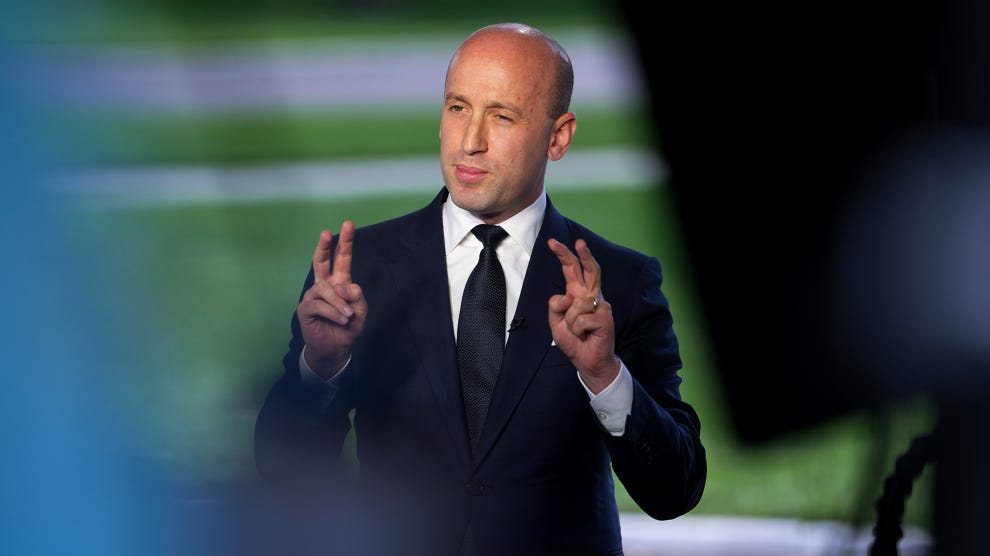
The most chilling articulation of this new reality came not from the President, but from his architect of domestic policy, Stephen Miller. In a hit on The Ben Shapiro Show on Tuesday, Miller didn’t just defend the shooting; he outlined a legal theory that effectively erases the Fourth Amendment.
“The media is obsessed with ‘probable cause,’” Miller sneered. “But they are ignoring the Unitary Executive. When a federal agent issues a command in the field, he is acting as the direct avatar of the President. To refuse that command—to debate it, to delay it, to be ‘mouthy’—is not a civil liberty. It is an act of insurrection against the Executive Branch. The citizen’s duty in that moment is not to evaluate the legality of the order. The citizen’s duty is to submit.”
Read that again. Miller is arguing that the agent is the law. He is arguing that the badge does not merely convey authority; it conveys sovereignty. Under this framework, there is no such thing as an unlawful order, because the source of the order is the President, and the President is the law.
This is not a “law and order” position. It is the Führerprinzip—the “leader principle”—translated into American legalese. It posits that the will of the leader, expressed through his agents, supersedes written law. It transforms the citizen from a rights-holder into a subject whose only legal standing is the obligation to obey.
“Didn’t you learn from the other day?”
The statement haunts me because of what it reveals about how these agents understand their role in American life. They are not embarrassed by the killing of Renée Good. They are not chastened by it. They are not worried that it might cause their agency to face scrutiny or reform. They view it as a successful demonstration of dominance, and they expect the population to respond accordingly.
This is the psychology of occupation, not policing. An occupying army does not serve the local population; it controls them. It does not derive its legitimacy from public approval; it derives its legitimacy from force. The relationship between occupier and occupied is not one of mutual obligation but of unilateral submission. The occupied learn the rules—where not to go, what not to say, how to comport themselves in the presence of armed men—or they suffer the consequences. “Didn’t you learn from the other day?” is not a question a public servant asks. It is a question a prison guard asks. It is a question a soldier asks in a country he does not consider his own.
The men who say these things chose to be here. They applied for these jobs. They underwent training. They swore oaths. They could quit tomorrow and no one would stop them. If the work is too stressful—if the sight of a slowly moving vehicle triggers a lethal response, if the presence of bystanders with cameras feels like a threat, if the exercise of restraint that the job requires is more than they can manage—then they should find other work. There are many jobs in America that do not require you to carry a weapon or exercise judgment over who lives and dies. Those jobs would suit them better.
But of course they will not quit, because the administration has made clear that restraint is no longer required. The old rules—the ones about de-escalation, about proportional response, about the use of force as a last resort—have been “unleashed.” The consent decrees that once mandated reform have been rescinded. The civil liability that once created financial incentives for caution has been indemnified away. The President himself has announced that agents should not have to put up with mouthy citizens.
What remains is the pure exercise of power, unchecked by consequence. And the agents who wield that power are learning, as agents in such positions always learn, that the absence of consequence is permission. Each killing that goes unpunished is a lesson—not to the public, though it is that too, but to the agents themselves. They are learning what they can get away with. The answer, so far, is everything.
A Standing Army
U.S. District Judge William Young, a Reagan appointee, wrote an opinion in September 2025 that deserves to be widely read. The case involved the detention of pro-Palestinian students by masked ICE agents, but Young’s analysis ranges far beyond that specific injustice.
On the practice of masking: “ICE goes masked for a single reason—to terrorize Americans into quiescence. We have never tolerated an armed masked secret police. To us, masks are associated with cowardly desperados and the despised Ku Klux Klan.”
On the administration’s justifications for the practice: “Disingenuous, squalid, and dishonorable.”
On the difference between these agents and the military: “Small wonder ICE often seems to need our respected military to guard them... It should be noted that our troops do not ordinarily wear masks. Can you imagine a masked marine? Honor still matters.”
Judge Young saw what the masking was for, and he named it plainly. The masks sever the connection between act and actor. You cannot file a complaint against an agent you cannot identify. You cannot testify against a face you never saw. You cannot name your assailant in a lawsuit. The mask is impunity made physical—a way of ensuring that even if the legal architecture of accountability somehow survives, no individual agent will ever be held responsible for anything.
But the masks serve a symbolic function too. They communicate something about how the agents understand their relationship to the public. A police officer in the Peelian tradition is your neighbor in uniform—someone whose face you know, whose name you can learn, who will have to live in the community he polices long after this particular encounter is over. A masked agent is something else entirely: a figure of anonymous menace, interchangeable with every other masked agent, accountable to no one outside the hierarchy that deployed him. The mask says: I am not your neighbor. I am not your servant. I am something that has been done to you.
The Founders feared exactly this. They had lived under an army that answered only to the Crown, and they spent considerable effort designing a system in which such a force could never again be deployed against the American people. The Third Amendment. The Posse Comitatus Act. The entire structure of civilian control of the military. All of it was aimed at one goal: ensuring that armed men would never be able to operate in American communities without accountability to the people who live there.
And here we are. Masked agents in unmarked vehicles, answerable only to federal superiors, immunized from state prosecution, indemnified from civil liability, operating under administrative warrants no judge has reviewed, killing citizens who are deemed insufficiently submissive and then warning bystanders to learn from the example. The standing army the Founders warned about has arrived. It is just wearing a DHS patch instead of a red coat.
What Submission Buys You
There is a school of thought—you hear it from the “reasonable” Republicans, from the pundits who urge calm, from the citizens who just want the trouble to stop—that the answer is compliance. Just do what they say. Don’t be mouthy. Don’t make trouble. The agents are under stress. The work is dangerous. Cooperate and you’ll be fine.
This theory has been tested extensively throughout history, and the results are not encouraging. Authoritarian systems do not reward submission with safety. They reward submission with additional demands for submission. The compliant citizen who keeps his head down today will be asked to inform on his neighbors tomorrow. The community that allows its “troublemakers” to be taken without protest will find that the definition of troublemaker expands to include anyone insufficiently enthusiastic in their support. The lesson the agents are teaching—”Didn’t you learn from the other day?”—is not a one-time lesson. It is a curriculum. There is always another lesson.
Renée Good was not a troublemaker by any reasonable definition. She was a 37-year-old mother of three, a poet, a woman who went to observe federal agents operating in her neighborhood because she was worried about her neighbors. She was not blocking the agents. She was not interfering with their operation. She was watching. And she is dead, and the President of the United States has explained that she should have known better than to be mouthy, and the agents who killed her have moved on to teaching the next lesson.
Compliance would not have saved her. Compliance cannot save you. The premise of compliance—that there is a stable set of rules, that following those rules will protect you, that the authorities will be satisfied by your submission—does not apply to a system in which the rules change daily and the authorities are never satisfied. The only stable rule in such a system is that the authorities are always right and you are always wrong, and the only safety is the safety of being beneath notice, which is not safety at all but merely the temporary absence of attention.
The Record
I am not going to end this essay with a call to action, because I do not know what action to recommend. The mechanisms designed to prevent what is happening have been disabled or captured. The courts are slow and increasingly hostile. The legislature is controlled by collaborators and cowards. The states that try to resist are being sued into submission or threatened with military force. The people who spent decades warning about government tyranny have revealed that they were fine with tyranny all along, so long as it targeted the right people.
What I can do—what any of us can do—is refuse to pretend that this is normal. Refuse to adopt the language of the administration, which calls masked agents “law enforcement” and calls their victims “terrorists.” Refuse to let the Overton window slide so far that we forget what policing was supposed to mean, what citizenship was supposed to mean, what the relationship between a free people and their government was supposed to look like.
The Founders understood that rights exist only as long as people insist on them. The Bill of Rights is not self-executing. It is a set of principles that must be asserted, over and over, by people who refuse to accept the alternative. The moment we stop asserting them—the moment we decide that compliance is easier, that silence is safer, that the agents probably know best—we have already lost. Not because the rights have been formally repealed, but because they have been rendered meaningless by our unwillingness to claim them.
Renée Good claimed her rights. She stood on a public street in her own neighborhood and watched federal agents conduct an operation. She asked questions. She was, by the President’s own account, mouthy. And she is dead, and the men who killed her are still working, and the President has explained that this is how it should be.
I am writing this down because the record matters. Because someday, someone may want to know how it happened—how a country that once understood itself as a nation of citizens became a nation of subjects, how armed men in masks came to patrol American streets with impunity, how the people who could have resisted chose silence instead. The record will show that some of us refused. That we named what was happening, even when naming it was dangerous. That we did not learn the lesson of the other day.
That we remained, to the end, mouthy.
85 years ago humanity was given a lesson. Unfortunately, it appears it wasn’t fully learned. Therefore humanity has to try to learn it again.
I am reminded that our greatest learning often comes during the darkest times, when we are shaken out of our reality and forced to come to terms with new truths about ourselves. Whether you believe it or not, we chose to come here to the planet to be alive at this time in history. We know that boiling water is more effective at cooking a potato than lukewarm.
I'm "safely" in Canada and shaking in my boots. You've said it all and said it well. Thank you. Thank you.