



A reminder for new subscribers who signed up thanks to “The Dead Economy Theory”—this isn’t primarily an AI or econ publication. There will be plenty of that, and if that’s what you’re interested in, you can select to receive only “are belong to us,” the vertical here that speaks to that.
The Sausage King of Chicago taught me that life comes at you fast. How fast, though, depends on what we’re accustomed to and what we’re accustomed to morphs without us noticing. I recently rewatched Rear Window (one of my favorite films, because of course it is) and The Postman Always Rings Twice (also a favorite, but here to hone a passage in my novel where characters discuss it). Both of these films are, in their own way, thrillers. And, today in 2026, these films moved so slowly. Slower than I remembered. Where were the jump cuts? The camera just…lingers.
It took me a good twenty minutes of watching these works to ease into the pacing, to stop reaching for my phone, to recalibrate to this measured pacing where tension is built through the play of the mind rather than through constant stimuli. Both films are based on classics in noir crime fiction, and the method of Rear Window, based on Cornell Woolrich’s short story “It Had to Be Murder” only works if we allow the mind to wander and do its thing. Jeff, a photojournalist recuperating from a leg injury suffered in the field, is wheelchair-bound and using his time to watch his neighbors. (I’m recapping this as if you haven’t seen the film, and if you haven’t, Jesus Christ, stop reading my tripe and spend your time on something beautiful.)
Jeff becomes convinced that one of his neighbors has murdered his wife. He calls in a buddy of his, a private investigator, who finds no evidence of malfeasance. Jeff slowly goes a little mad watching all of his neighbors, each of whose lives he had hitherto ignored, get up to, well, living. And with enough time on one’s hands, a human brain can concoct all kinds of strange stories for what amounts to “living.” I’m not going to say more about how the story plays out in the off-chance you haven’t seen it—but what I find fascinating is the film turns on the idea that the mind, given time and opportunity, will invent all kinds of wild tales.
I spent last week revising Pennhollow, seeking to speed it up. The book is part bebop noir, part fractured modernism, and part absurdist. The smokiness of Pittsburgh in the 40s isn’t simply a setting. It’s a character in its own right, seething and flexing its industrial muscles. Underlying the mood, though, is, well, a noir soap opera, a story with stakes and people fighting for themselves and the lives they want. Too much of the propulsive story got lost in the ruminating moodpiece of the thing. So I set about to dig some of it out, to make it more visible. And this, I reckon, is an attempt to make it more modern—more palatable to the contemporary reader and market.
This made me uncomfortable, the nagging question of whether I was revising simply to improve chances at publication, making commercial choices rather than artistic ones. I did the hard thing: I sat with it and didn’t brush it aside or make a jump cut to the next thought. I put on the playlist of songs for Pennhollow, listened to a ton of jazz with my son, dancing to impossible-to-dance-to bebop tracks with him. I came to the conclusion (or the rationalization) that I was being a pretentious, uptight douche who was contemplating made-up artistic rules.
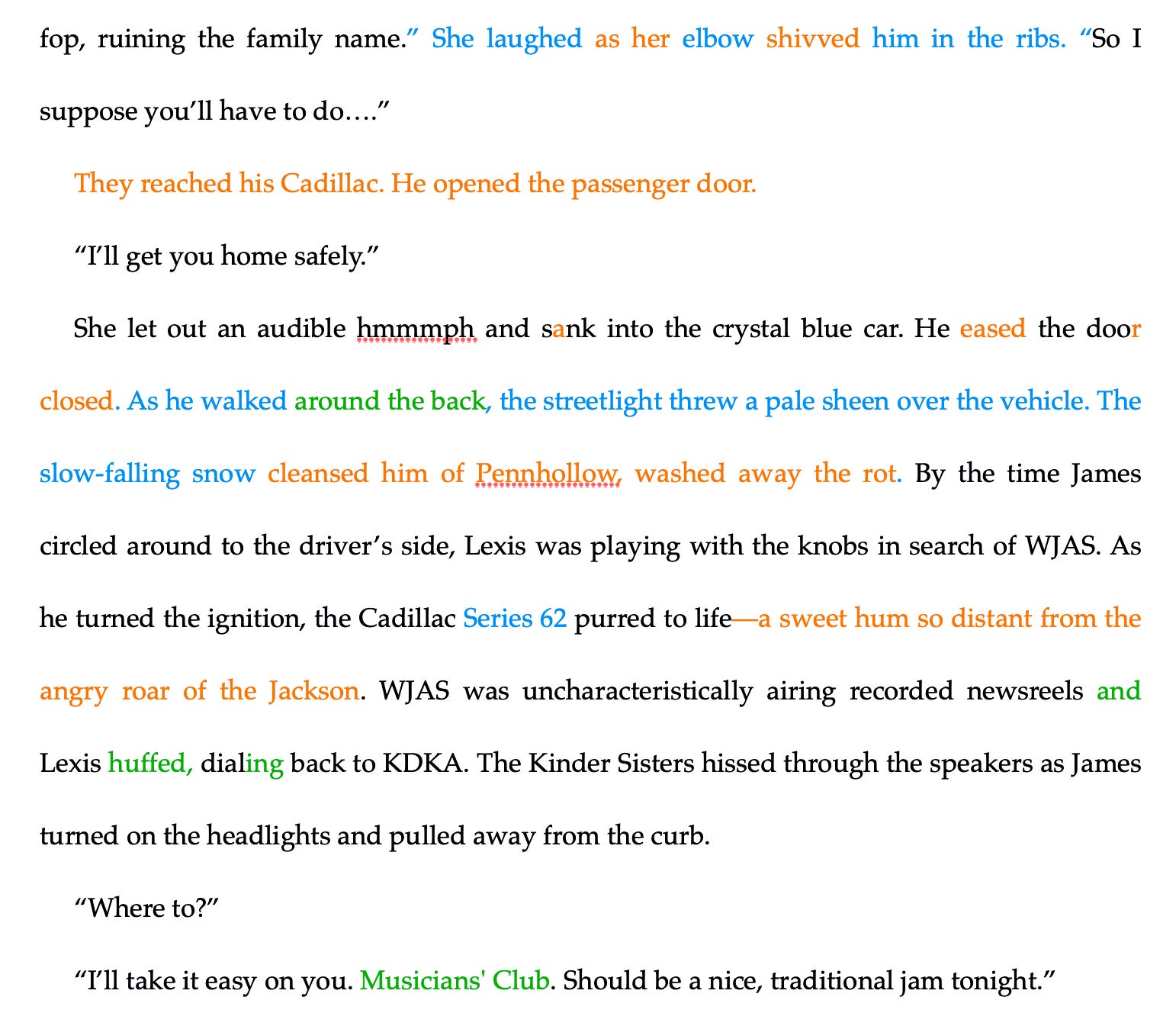
A buried story can work. The telling of a story can be the excavation of it. Hell, there’s a reason The Good Soldier is namechecked not once but twice in Pennhollow. But the story has to be seen to work. It has to be visible enough to catch a reader and earn the turned pages through the end. There’s nothing wrong with wanting to be published, nor anything wrong with the desire to be read—why tell a story if you are so precious about the so-called “art” of it that nobody wants to read it, let alone publish it?
Perhaps both can be true and in conflict at the same time. Perhaps the soap opera (or the “melodrama” as my editor prefers to put it) isn’t in conflict with the shattered timeline and broken consciousnesses. Perhaps all of it builds into something stronger because of the tension. When I look back at this latest revision, it doesn’t lay everything out on the table for everyone to see. You see everything reflected through the glint of the knives in the place settings.
Ecclesiastes 1:9
I want to be one of those people that drops a Bible verse and then leaves, but I am not.
Write YOUR book. That may seem contrary to my mystery verse.
But there are millions of books in the world (billions?bazillions?) and supposedly 7 basic storylines. (7 is such a great number for putting a cap on things.)
Don't be an airport novelist that I can read on one flight and return the book at the next airport for a discount.
Palatable like cake has never been you. You could have chosen cake all along.
"But the story has to be seen to work. It has to be visible enough to catch a reader and earn the turned pages through the end." In college we were assigned the novel Clarissa, Or The History of a Young Lady by Samuel Richardson. It was a lengthy epistolary novel; the closest thing to a jump cut was moving from the end of one letter to the beginning of the next. Spoiler alert for anyone who is thinking of reading Clarissa - there is a rape late in the book. Curiously, in talking to classmates, most did not know that a rape had occurred. My point is this: I agree that the story needs to be visible enough to catch a reader. That said, you are not going to catch every reader. Ultimately, you should write your novel the way you want to write it.