



Donald Trump is massing two aircraft carriers, a dozen warships, and hundreds of fighter jets for a second major military assault on Iran — a nation of 90 million people with substantial air defenses and 30,000 American troops within retaliation range. He has not consulted Congress. He has not articulated objectives. He mutters about regime change in the same breath as calling it a limited strike. His press secretary, she of the machine-gun lips, asked whether the president would wait for ongoing diplomatic negotiations before bombing a sovereign nation, declined to answer.
He doesn’t believe he needs to ask because he already knows what happens when he doesn’t.
On January 3rd of this year, Trump ordered Delta Force into Venezuela, captured its president, killed approximately eighty people, and announced that the United States would henceforth “run” the country. Congress was notified after the operation was already underway. When asked why he hadn’t consulted lawmakers in advance, Marco Rubio explained that it simply wasn’t “the kind of mission that you can do congressional notification on.” The Senate tried to pass a war powers resolution. JD Vance flew to Capitol Hill and cast the tie-breaking vote to kill it. The administration had previously told Congress, in writing, that it had no plans for regime change in Venezuela. That assurance, it turned out, was worth exactly what this administration’s assurances are always worth.
Six months earlier, Trump had bombed three Iranian nuclear facilities without congressional authorization, without notifying Democratic leadership until American planes had already cleared Iranian airspace, on a legal justification so thin it wouldn’t survive a first-year constitutional law seminar: “inherent authority” and “collective self-defense of Israel.” Congress grumbled. A war powers resolution was introduced. A ceasefire arrived and made looking away convenient, so they looked away. God forbid having to do some work and put a vote on the record.
The administration has now conducted unauthorized military operations against Venezuela and Iran in the span of seven months. Congress has not stopped them once. And so here we are again—larger force, higher stakes, zero consultation—the White House having correctly internalized that the embarrassment of asking has always outweighed, in practice, the constitutional requirement to do so. This is not a crisis that arrived without warning, but the entirely predictable consequence of a legislature that has spent fifty years treating its own constitutional authority as an inconvenient inheritance best left unclaimed.1 And it is being done, with straight faces, by men who call themselves originalists.
That claim deserves to be examined until it breaks.
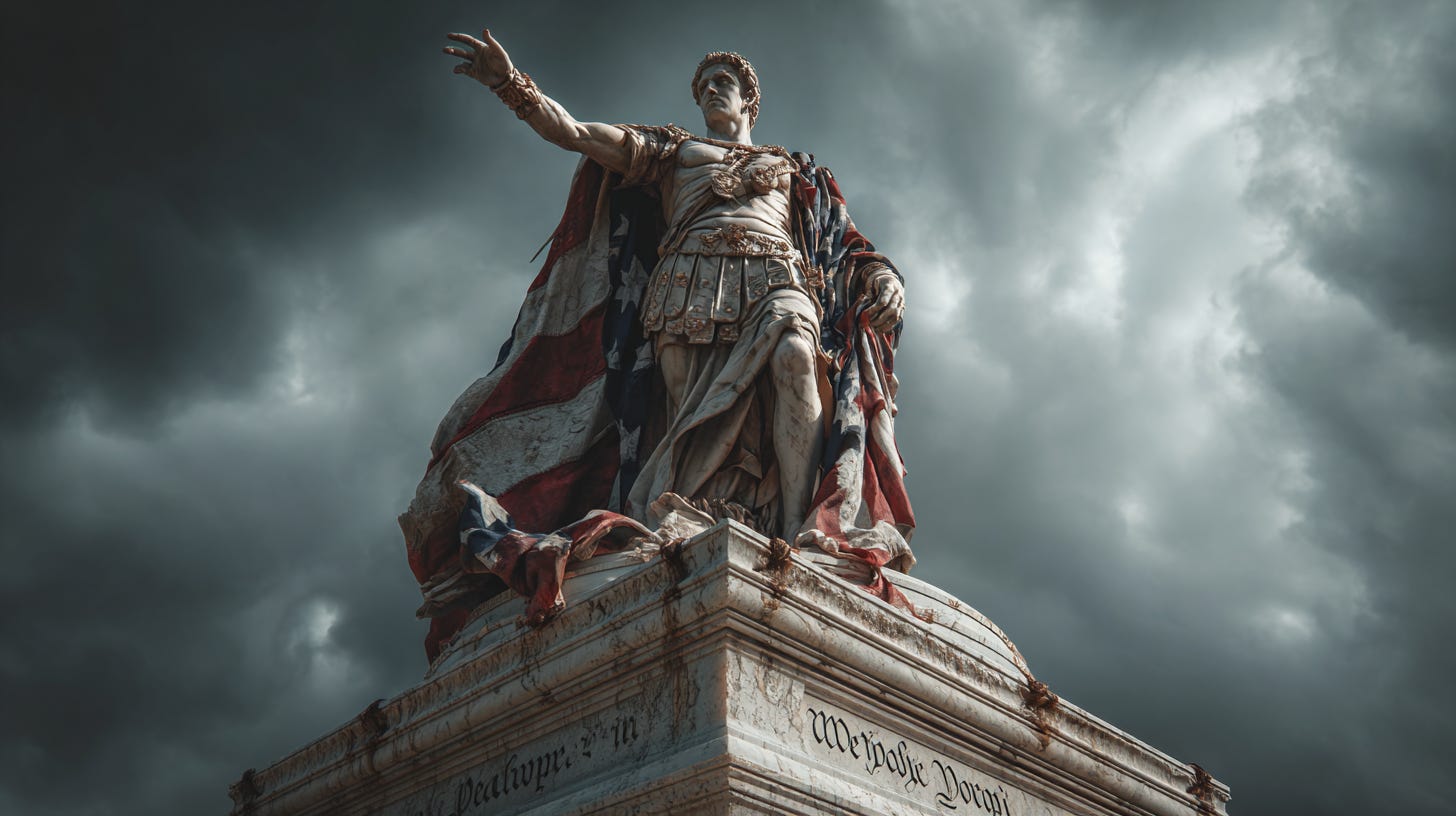
The unitary executive theory, the legal architecture constructed to justify precisely this, requires accepting that the founders were either historically illiterate or lying through their teeth. Its architects have made their peace with the second option. We've always been at war with Eurasia. Consider what they have to explain away. Alexander Hamilton—a man who rarely encountered an executive power he didn’t want to touch, who argued for a vigorous presidency at every turn—drew a line in Federalist No. 69 so explicit it reads today like a warning aimed directly at them:
“It would amount to nothing more than the supreme command and direction of the military and naval forces... while that of the British King extends to the declaring of war and to the raising and regulating of fleets and armies—all which, by the Constitution under consideration, would appertain to the Legislature.”
Hamilton wrote that to promise a skeptical republic it was not trading a British monarch for an American one. He knew the fear. He answered it directly. The unitary executive crowd has spent fifty years crowning the very king Hamilton swore did not exist…in his name, with his papers, waving his Federalist essays like a forged deed to property they stole.
James Madison left even less room. The man who drafted the Constitution, whose intentions are not a matter of inference, wrote to Jefferson in 1798 with the patience of someone who had already thought this through completely:
“The Constitution supposes what the history of all governments demonstrates, that the executive is the branch of power most interested in war, and most prone to it. It has accordingly with studied care, vested the question of war in the legislature.”
Studied care. The architect explaining the building. Not a riddle. Not a suggestion. Madison expected posterity to be literate. That was his mistake.
What the imperial presidency actually is, beneath the borrowed robes, is the thing the Federalist Society has built careers denouncing: living constitutionalism, practiced with total shamelessness in the one area where its practitioners like the outcome. The same legal movement demanding textual fidelity on the Second Amendment, the Commerce Clause, the administrative state, quietly abandons the entire methodology when the text says something that inconveniences the Oval Office. The Declare War Clause doesn’t get amended; that would require honesty and a two-thirds majority. Instead it gets bled out in the subbasements of the Justice Department, one OLC memo at a time, each unauthorized military action recycled as precedent for the next, a shadow constitution built by lawyers whose work no elected official ever has to defend in public. The work of men and women who mistake the President for their client, and their client for the sovereign.
Congress is not a victim of this racket. It is a co-conspirator. Madison vested the war power in the legislature because he understood, with the clarity of someone who had studied the collapse of republics, that executives hunger for war and legislatures are structurally more reluctant to start one. That theory required only one thing to function: a Congress willing to act like one. What we got instead was fifty years of blank-check AUMFs stretched past any recognizable limit, a War Powers Resolution that every administration since Nixon has reported against “consistent with” rather than “pursuant to”—a lawyerly genuflection that is its own form of contempt—and a political class that somehow made asking Congress for permission the embarrassing option.
Last June, when the moment came, most of them went home. This week, as warships move into position for a potential strike on a nation of 90 million people, the Republican congressional majority is meeting the constitutional crisis with the moral urgency of a game of Go Fish.
Two members of Congress are trying to stop this. Thomas Massie, a libertarian Republican from Kentucky. Ro Khanna, a progressive Democrat from California. They agree on almost nothing and keep finding each other anyway, because no one else showed up for work. Together they passed the Epstein Files Transparency Act through a discharge petition that had to go around their own leadership. They got it signed into law. When Pam Bondi’s Justice Department defied the statute, missed deadlines, over-redacted, withheld materials the law explicitly required to be released, Massie and Khanna threatened inherent contempt. Not a press release. Constitutional hardball, from the institution that is supposed to be full of it. Now they are trying to force a floor vote before Trump bombs Iran a second time. They will almost certainly fail. Their colleagues are busy fundraising for reelection.
Two. Out of five hundred thirty-five.
King George III would have recognized the power. What would have astonished him is the audacity of clothing it in the language of liberation, of watching an executive dismantle every constitutional constraint on war-making while the lawyers who built the apparatus invoke the founders by name.
Those founders wrote their intentions in plain English, argued them in public, and put their lives behind them before they affixed their signatures. Hamilton’s promise is not ambiguous. Madison’s letter is not ambiguous. The Declare War Clause is four words followed by a comma. The ambiguity is manufactured: produced on demand, in law reviews and OLC memos, by people who needed the text to say something other than what it says, and who have built careers on the pretense that this requires genuine intellectual effort rather than the raw will to power it actually reflects.
To defend what is happening right now is to confess that you don’t care what the Constitution says, only who holds the sword.
So stop calling yourselves originalists. Stop invoking the founders you are betraying. Stop pretending this is constitutional law rather than what it plainly is: the deliberate construction of exactly the executive the founders built this document to prevent. They had a word for it. They knew it when they saw it. They wrote down, in considerable detail, how to stop it.
We just decided not to.
At some point, I will write about the debasement of Congress by those who sit in its once-august chambers. It is their fault as much as it is Trump’s—probably more their fault than Trump’s—that we are where we are. But, man, I just don’t have the heart for it right now.
So what's the exit ramp? You have a feckless/complicit Congress, an untethered King and the 'man' in the street is so mired in their own struggles that they don't have time for anything else.
They stole the 2A right out from under your feet and I didn't hear a peep out of the NRA. So it all looks like performative buffoonery.
So all that aside, what's the play?
What's America in a decade?
How bad does it have to get until someone takes the wheel?
Is there anyone left who can or will?
I had a whole big comment written out but then deleted it. Because I know that you know that ordinary people don’t care about any of this. They don’t care about what the Constitution says, as long as it is helpful to them in the moment. And if it’s not, they either look for a workaround or blatantly ignore it. The only reason most people know the Founding Fathers you’ve named is because they caught the show when it came through town (or watched the special on TV).
So instead I’m going to focus on a point you made that could easily get overlooked here. And that is that all this didn’t just happen overnight. You trace it back fifty years. I could argue it goes back hundreds of years, if not tens and hundreds of thousands of years.
For most of recorded history humanity has focused on conquest, expansion, aggression, and power. We have raped and pillaged the planet and its resources for our personal benefit. We have raped and pillaged each other for the same thing. We have created religions and beliefs systems around some people being better and more deserving than others. We have lost touch with our connection to nature and our intuition. We have pushed forward with technology and “advancement” without considering the impact on everything else around us. The path was set long ago, but it has been accelerated within the last few generations.
The result is the chaos we see before us. After all, the external world is a reflection of our collective internal world. This is what happens when the rubber band gets stretched to its limit. It snaps back.
*I had a wonderful gif to go with this comment. But alas, Substack doesn't allow images as comments to posts, only to Notes.