

Quis custodiet ipsos custodes?
The Department of Justice Would Like to Investigate Itself


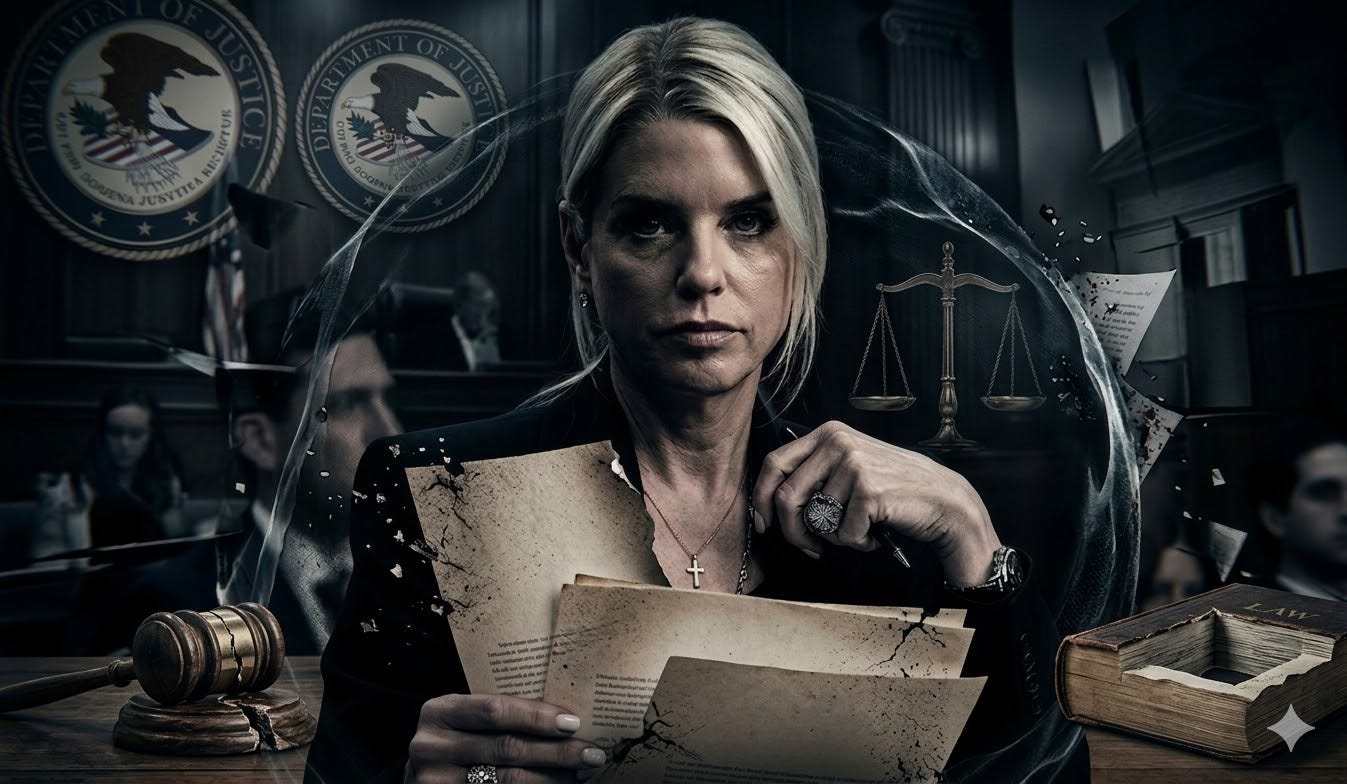
On March 5, the Department of Justice published a proposed rule in the Federal Register that would, if adopted, give the Attorney General the right to review, delay, and effectively kill state bar investigations into the professional conduct of DOJ attorneys. The comment period closes April 6. You should comment. I did, and the text of mine is below. If you are concerned about your name being associated with something that pushes back against what this regime is doing, you can submit anonymously.
But first, some background on what the Department is actually trying to do here, because the Federal Register version runs to fifteen pages and is written in the kind of prose that exists to make you stop reading.
What This Is About
Every lawyer in the United States is licensed by a state. That license comes with obligations—to the courts, to the law, to the profession—that exist independently of whoever happens to be paying you. When a lawyer lies to a judge, fabricates a legal justification, or subordinates their professional judgment to their boss’s political preferences, the state bar is one of the institutions charged with doing something about it. This is true whether you work at a two-person firm in Altoona or at the Department of Justice.
The Department of Justice does not care for this arrangement.
Over the past year, bar complaints have been filed against senior DOJ leadership and, given the track record of AUSAs pursuing immigration and other insane administration tactics, we are going to see an avalanche of such complaints—both merited and not. More than seventy lawyers and former judges, including two former Florida Supreme Court justices, requested that the Florida Bar investigate Attorney General Pam Bondi for allegedly pressuring DOJ lawyers to violate their professional obligations. Eagle Ed Martin, variously the Acting US Attorney for the District of Columbia, the head of the Weaponization Task Force, and the Pardon Attorney, is in the barrel at the moment (and acting like the utter clown that he is). The Legal Accountability Center filed a complaint against Deputy Attorney General Todd Blanche with the New York Attorney Grievance Committee. Blanche, for his part, told a Federalist Society audience that the Department was in a “war” against bar associations and promised to curtail their oversight powers.
He was not speaking metaphorically. The proposed rule is the curtailment.
What the Rule Does
The Department has proposed adding a new § 77.5 to 28 CFR Part 77. In plain language, this is what it would do:
When someone files a bar complaint against a DOJ attorney—or when a state bar opens its own investigation—the Attorney General gets to review the matter first. The AG will “request” that the state bar suspend its investigation while the Department conducts its own review through the Office of Professional Responsibility, which reports to the Attorney General. If the state bar declines this request, the Department will take “appropriate action” to prevent the bar from proceeding.
That’s the rule. The Department’s own internal office, reporting to the official whose subordinates are being investigated, gets first crack at every complaint. The state bar, which exists to provide independent oversight, is told to wait. And if it refuses to wait, the Department has reserved the right to make it.
The Department’s legal theory is that 28 U.S.C. § 530B, the McDade Amendment, authorizes this. The McDade Amendment says DOJ attorneys “shall be subject to State laws and rules...to the same extent and in the same manner as other attorneys in that State.” The Department reads “same manner” to mean “different manner, one where your employer gets to vet the complaint before the licensing authority sees it.” No other attorney in America has this arrangement. Your state bar does not call your managing partner before investigating you.
Why You Should Care
This is not a technical dispute about federal rulemaking procedure. This is the executive branch of the United States government proposing to exempt its own lawyers from independent professional accountability. The implications are not subtle.
A DOJ attorney who lies to a federal court would, under this rule, have the matter reviewed first by the office that employs them, supervised by the official who may have directed the lie. The state bar, the independent institution the public has charged with holding lawyers accountable, would be told to stand down. And the rule contains no requirement that the internal review ever conclude. The Department could, in effect, suspend state bar oversight indefinitely simply by opening a file.
If you are a lawyer, this is an attack on the licensing system that governs your profession. If you are not a lawyer, this is an attack on one of the few remaining mechanisms by which government attorneys are held accountable for their conduct in court.
What You Can Do
The comment period is open until April 6, 2026. You can submit a comment at regulations.gov. You do not need to be a lawyer. You do not need to write fifteen pages. You need to tell the Department that a government that investigates itself is not being investigated.
If you are a lawyer, say so. State your jurisdiction. It matters. If you are not a lawyer, say that too; the rule affects anyone who has an interest in government attorneys being accountable for what they do in court, which is everyone.
If you want to crib from mine, you have my blessing. It’s below.
My Comment
Submitted to Docket No. OAG199, Department of Justice, 28 CFR Part 77
My name is Owen McGrann. I am an attorney licensed in the Commonwealth of Pennsylvania since 2009 and the founder of a law firm based in Pittsburgh. I submit this comment in my individual capacity.
The Department of Justice has, with the serene confidence of an institution that has forgotten what shame feels like, proposed a rule by which it would grant itself the right to review, delay, and effectively neutralize independent state bar investigations into the conduct of its own attorneys. One searches the history of federal rulemaking for a comparable act of institutional self-dealing and comes up mostly empty. The Department has outdone itself. This is a remarkable achievement for an agency whose nominal purpose is the administration of justice rather than its administration into quietude.
The comment that follows will endeavor to treat this proposal with the seriousness its authors deserve, which is to say: considerably less than they believe, and rather more than they would prefer.
I. What This Rule Actually Is
The Department informs us, with an admirably straight face, that this rule is necessary because “political activists have weaponized the bar complaint and investigation process.” This is the Department’s characterization of what happens when independent licensing authorities—created by states, answerable to states, vested by law with the responsibility of ensuring that attorneys do not lie to courts, fabricate evidence, or subordinate their professional duties to their employer’s political preferences—do precisely what they exist to do.
The Department does not like this. It has decided that the appropriate remedy is a federal regulation.
Let us be precise about what is being proposed, because the rule’s authors have taken considerable care to obscure it in the sober bureaucratic language of process and procedure. The Department proposes that before any state bar may take any investigative step in response to a complaint against a Department attorney, the Attorney General shall have the right to review the matter first, request that the bar stand down, and, should the bar decline this gracious invitation, take “appropriate action” to stop the bar from proceeding. The Department will investigate itself. It will report its findings to the bar. The bar may then, at its leisure, disagree.
This is not an oversight mechanism. It is an oversight mechanism’s tombstone, engraved with the words “existing practices” and “consistent application of uniform standards” to lend the epitaph an air of administrative normalcy.
II. The Statutory Argument, Which Does Not Survive Contact With the Statute
The Department’s legal theory rests on 28 U.S.C. § 530B, the McDade Amendment, which provides with admirable clarity that Department attorneys “shall be subject to State laws and rules...governing attorneys in each State where such attorney engages in that attorney’s duties, to the same extent and in the same manner as other attorneys in that State.”
The Department reads “to the same extent and in the same manner” to mean “subject to the same substantive rules, but through an enforcement mechanism available to no other attorney in America.” This is a remarkable interpretive feat. It requires one to conclude that Congress, in writing the words “same manner,” intended to authorize a categorically different manner, one in which the attorney’s employer may suspend the investigation, shape the evidentiary record, and report conclusions to the licensing authority before that authority is permitted to form its own. One imagines the Congress that passed this language would be surprised to learn what it had wrought.
The Department then reaches for McCulloch v. Maryland and the intergovernmental immunity doctrine to suggest that state bars have no authority over federal attorneys absent explicit congressional authorization, while simultaneously arguing that § 530B(b) grants the Attorney General broad rulemaking authority to structure enforcement as she sees fit. These two propositions cannot coexist. If intergovernmental immunity shields Department attorneys from state bar jurisdiction, then § 530B provides no hook for state bar authority whatsoever, and the Department’s rulemaking power under § 530B(b)—which exists to “assure compliance” with the statute—regulates nothing. If § 530B does create state bar jurisdiction, as the Department implicitly concedes by invoking it, then the “same manner” language means what it says, and the proposed rule violates it.
The Department has constructed an argument that devours itself. That it has done so across fifteen pages of institutional Federal Register prose does not make it more persuasive. It does make it more impressive, in the way that a very large error is more impressive than a small one.
III. The Threat Hiding in Subsection (b)
Proposed § 77.5(b) provides that should a state bar “refuse the Attorney General’s request,” the Department “shall take appropriate action to enforce this regulation or to prevent the bar disciplinary authorities from interfering with the Attorney General’s review.”
“Appropriate action.” Against state licensing bodies. For conducting their lawful investigations.
The Department declines to specify what this action might be, which is itself instructive. Vagueness of this kind in regulatory language is rarely accidental. What is clear is that the Department has reserved to itself the power to coerce independent state institutions into subordinating their oversight authority to the office they are supposed to be overseeing. This is not federalism as the Constitution envisions it. It is federalism as a protection scheme: the states may retain their licensing authority, provided they exercise it only when and how the federal government permits.
It is worth pausing here to appreciate the moral architecture of this provision. The state bars exist, in part, to protect the public from attorneys who abuse their positions. Department attorneys, like all attorneys, owe duties to the courts and to the law that exist independently of and in tension with their duties to their clients—including when that client is the United States Government. When a Department attorney allegedly lies to a court, or fabricates justifications for unlawful action, or subordinates their professional judgment to their superior’s political preferences, the state bar is among the institutions the public has charged with accountability. The proposed rule would allow the Department to tell that institution to wait in the hall while the Department reviews the matter internally, and to face unspecified federal action if it declines.
A government that can immunize its own lawyers from independent professional accountability has acquired a power that no government in a free society ought to possess. The Department proposes to acquire it through a notice-and-comment rulemaking. The audacity is, one must admit, breathtaking.
IV. The OPR Fiction
The Department proposes that the Office of Professional Responsibility—which reports to the Attorney General, whose attorneys it will be investigating—will serve as the neutral first-instance reviewer of complaints. We are asked to accept that an office whose continued existence, budget, and leadership depend on the goodwill of the official whose subordinates it investigates will nonetheless render dispassionate, independent judgments about whether those subordinates have engaged in professional misconduct.
The Department notes, as though this resolves the concern, that state bars are not required to defer to OPR’s findings. This is both correct and entirely beside the point. The rule does not need to mandate deference to achieve deference’s practical effects. It needs only to allow OPR to investigate at length, produce a record, and report conclusions to the state bar, after having delayed the bar’s own investigation by months or years, and the bar’s subsequent review will inevitably proceed in the shadow of OPR’s prior determinations. There is nothing to require OPR to conclude an investigation at all. The Department proposes to remove a state bar from the process, in effect, if not strictly in process. This is how institutional capture works.
The Department has fifty years of OPR experience, it tells us, and OPR possesses unmatched expertise in evaluating Department attorney misconduct. One notes that fifty years of this expertise did not prevent the misconduct now generating bar complaints. One notes further that an investigator’s expertise in evaluating the conduct of the institution that employs them is precisely the kind of expertise that independence is designed to supplement, not replace.
V. What the Federalism Analysis Omits
The Department’s Executive Order 13132 analysis concludes that this rule lacks sufficient federalism implications to require a summary impact statement because it “merely better reflects the existing balance of responsibilities” between the Department and state bars.
“Merely.” A rule that explicitly authorizes the federal executive to prevent state licensing bodies from conducting lawful investigations into licensed attorneys, and reserves unspecified coercive authority for use against those bodies should they resist, “merely” reflects the existing balance. The Department’s facility with litotes is, in its way, as impressive as its capacity for overreach.
The states created their bars. The states license their attorneys. The states, through their bar disciplinary authorities, have long held that the obligations of an attorney to the court and to the law do not dissolve upon federal employment. This is not a radical position. It is the position of every jurisdiction in the country, codified in rules of professional conduct that predate the current administration by decades. It has never been the case that having a certain client affords an attorney special protections or rights. Doing so creates a parallel set of rules for attorneys, with government attorneys, who hold more awesome power simply by virtue of who their client is, exempted from true oversight. The proposed rule treats this settled understanding as an obstacle to be managed rather than a principle to be respected.
VI. Conclusion
Justice Robert Jackson, who knew something about the abuse of legal authority, observed that the prosecutor “has more control over life, liberty, and reputation than any other person in America.” He meant it as a warning about the temptations of unchecked power, and as an argument for restraint, integrity, and accountability in those who wield it.
The Department of Justice has responded to that warning by proposing a rule designed to ensure that when its attorneys are accused of misconduct, the first reviewer of that accusation will be the institution that employed them, supervised them, and whose leadership may have directed the conduct at issue. It has dressed this proposal in the language of expertise, consistency, and process improvement. It has cited McCulloch v. Maryland. It has invoked Executive Order 14147.
What it has not done is grapple honestly with the question that sits at the center of this entire enterprise: whether a government that can shield its own lawyers from independent accountability is a government that remains accountable to law. That question has an answer. The Department will not find it in subsection (b) of § 530B.
This rule should be withdrawn. The public, the legal profession, and the institution of the Department of Justice itself deserve better than a regulation whose primary achievement is ensuring that the next Department attorney who lies to a federal court will have the comfort of knowing that the first call goes to their employer.
Respectfully submitted,
Owen McGrann, Esq.
Pittsburgh, Pennsylvania
Wasn’t there a graphic novel about this?