



January 24, 2026. Minneapolis.
Why am I doing this again? Christ. I’ve thought about why I’ve sat at this keyboard for the last hour, and this is is the only answer I have: I am writing this because the record matters. I am writing this because I am a lawyer, and lawyers are taught that words have meaning, that facts have weight, that the law is a framework for peaceful coexistence rather than a weapon wielded by the powerful against the powerless. I am writing this because, as of today, I no longer believe those things are true in this country.1
My brother lives in Minneapolis with his wife and daughter. Earlier this week, when texting with him, he paraphrased Joseph Heller: “The law is what they can get away with.”
He’s right. And what they can get away with, as of today, is murder. Execution. Unwarranted. Unsupportable by facts or law.
This morning, federal agents executed an American citizen named Alex Jeffrey Pretti on a residential street in Minneapolis. He was thirty-seven years old—the same age as Renée Good, the woman they killed seventeen days earlier in the same city. He was an ICU nurse at the Minnesota VA. He went to the protest because that’s what nurses do: they go where people might need help.
His last act on earth was trying to shield a woman who had just been shoved to the ground by a Border Patrol agent. His arms were raised. He was holding his phone in his right hand—his shooting hand, for those keeping track. He was not involved in any altercation. He was filming. He was bearing witness.2

They pepper-sprayed him in the face. They pepper-sprayed him again at close range. He was blinded. They dragged him to the ground. Six agents piled on top of him. Only then—only after he was pinned and incapacitated—did they discover he had a holstered firearm. One agent removed it from the holster. That agent turned and walked away, his back to the scene, Pretti’s gun in his hand.
And then another agent shot Alex Pretti in the back. Execution-style. While he was kneeling. While he was pinned. While his own weapon was already in someone else’s possession.
Then they shot him again. And again. At least ten rounds in five seconds. Several of those rounds were fired into his motionless body after he had already collapsed.
Then they left.
I. The Flight
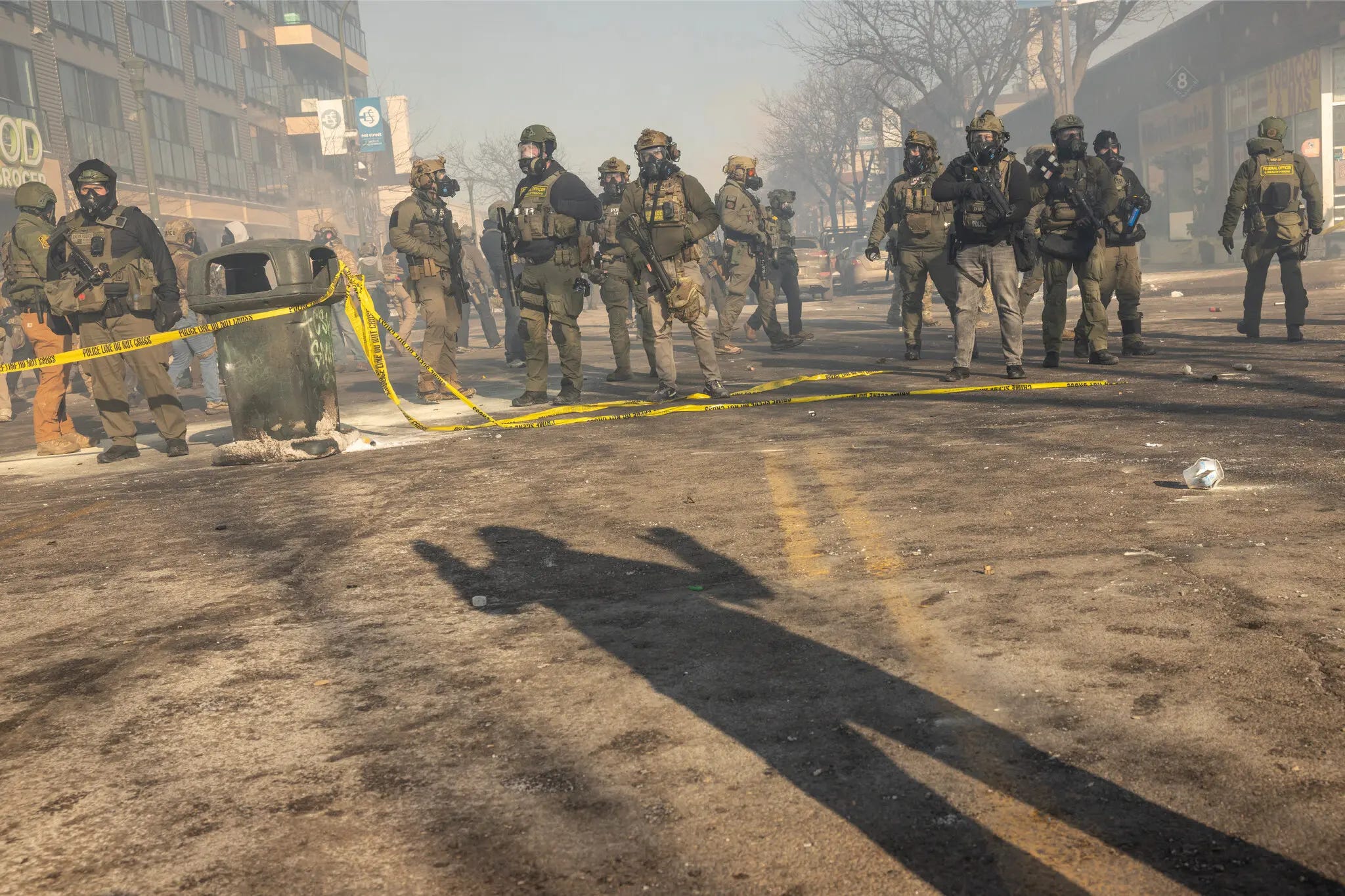
I need you to understand that law enforcement does not flee the scene of a shooting. Law enforcement secures the scene. Preserves evidence. Calls for medical assistance. Separates witnesses. Begins documentation. Notifies the chain of command. Cooperates with investigators. This is what legitimacy looks like. This is what distinguishes police from paramilitaries, officers from assassins. The willingness to be scrutinized. The submission to process.
The men who killed Alex Pretti did none of this. They shot him at least ten times. They watched him die. And then they got in their vehicles and drove away, leaving his body on the frozen pavement of a Minneapolis street.
In criminal law, we have a term for this: flight from the scene. It is admissible as evidence of mens rea—the state of a guilty mind. When a defendant flees after committing an act, the jury is permitted to infer that the defendant knew what they did was wrong. The flight is consciousness of guilt.
So I ask you: What does it tell us when federal agents kill a man and then run?
It tells us they knew. They knew this wasn’t a lawful shooting. They knew it wouldn’t survive scrutiny. They knew that if local law enforcement secured the scene, if witnesses were interviewed, if evidence was preserved, the official narrative would collapse under the weight of what actually happened.
So they ran. They ran knowing the Trump regime would hold them harmless. Protect them. Send them out again under the color of federal authority, masks up and trigger-happy.
When Minneapolis Police and the Minnesota Bureau of Criminal Apprehension arrived, they found chaos. The federal agents who committed the killing had fled. The state investigators didn’t have the manpower to secure the scene—because the killers had abandoned it.
Governor Walz asked the question that deserves to be asked: “You kill a man and then you just leave? Is there a single case in America’s history where you just walk away and say, ‘I guess that just happened and we’re not going to clean up our mess’?”
No. There isn’t. Because that’s not what law enforcement does.
What happened on that Minneapolis street is not, in any meaningful sense, a police action. It is closer to a lynching—state-sanctioned murder committed by masked men who know they will never be held accountable, followed by immediate flight, followed by official lies designed not to convince but to dominate.
II. The Assertion of Power
Within hours of the killing—before any investigation, before the body was cold—the official lies began.
DHS: “An individual approached US Border Patrol officers with a 9mm semi-automatic handgun.”
Gregory Bovino, Border Patrol: “This looks like a situation where an individual wanted to do maximum damage and massacre law enforcement.”
Stephen Miller: “A domestic terrorist tried to assassinate federal law enforcement.”
President Trump, posting a photo of Pretti’s firearm: “The gunman’s gun. Loaded. What’s that all about?”
We have the video. Multiple videos, from multiple angles, verified by the New York Times and other outlets. The videos show Pretti standing in the street, directing traffic, filming with his phone. Not approaching anyone. Not brandishing anything. The videos show that no one knew Pretti had a gun until after he was pinned. It was holstered. He never reached for it. An agent removed it from his holster, walked away with it, and then another agent shot Pretti in the back.
They know we have the video. They issued their statements because we have the video.
I have written before about “fuckery”—the assertion of a transparent falsehood not to deceive but to dominate. Fuckery does not attempt to change your mind. It demonstrates that your mind is irrelevant. It says: We know you know we’re lying. We don’t care. What are you going to do about it?
The answer to fuckery is not argument. You cannot debate someone who has already conceded, by the brazenness of their lie, that debate is beside the point. The answer to fuckery is witness. It is saying, clearly and without flinching: this happened. I saw it. Here is the record.
They want you to look away. They want the exhaustion to win. They want you to concede, by your silence, that their power to assert is greater than your power to document.
Do not give them that. Say the thing. The video shows what it shows. Alex Pretti was murdered by federal agents who then fled the scene. The official statements are lies. Put it on the record. Make them own it.
III. For My Friends, Everything
A United States Attorney for the Central District of California—a federal prosecutor—posted this after the killing: “If you approach law enforcement with a gun, there’s a high likelihood they will be legally justified in shooting you. Don’t do it.”
I read this, and I think: my God, people must be getting slaughtered by law enforcement left and right in Texas!
But of course they’re not. Because the rule this prosecutor articulated is not actually the rule. The rule he articulated applies only to certain people.
Alex Pretti did not “approach law enforcement with a gun.” He was standing in the street, filming with his phone. Federal agents assaulted a woman near him. He moved to help her. They pepper-sprayed him, blinded him, dragged him to the ground, discovered his legally holstered weapon, removed it, and executed him.
He had a permit. Minnesota is an open-carry state. He was exercising a constitutional right—two constitutional rights, actually: the First Amendment right to film public officials engaged in public conduct, and the Second Amendment right to bear arms.
For thirty years, a certain kind of American has built their political identity around these rights. They celebrated armed militias occupying the Michigan statehouse in 2020. They lionized January 6th participants, many of them armed and violent. When Ashli Babbitt was shot climbing through a window toward fleeing members of Congress, they called it murder. Trump gave her family five million dollars.
And now these same Americans are silent—or cheering—as federal agents execute a man for legal carry in an open-carry state.
Do you see?
The principle was never “citizens may bear arms.” The principle is that our people may do anything and their people may do nothing.
This is what Carl Schmitt, the Nazi legal theorist, identified as the fundamental distinction of politics: not right versus wrong, not legal versus illegal, but friend versus enemy. The law applies differently depending on which category you occupy. For friends, the law is a shield. For enemies, it is a sword.
Trump at the Ellipse on January 6th, frustrated that the Secret Service was screening rallygoers with magnetometers: “They’re not here to hurt me.”
The guns weren’t the problem. The allegiance was the question.
The Gadsden flag crowd spent decades warning about exactly this scenario. Armed federal agents. Tyrannical overreach. Citizens killed in the street. And now that it’s happening, they’ve revealed what they always believed: treading is fine, as long as the right people get tread upon.
IV. The Dual State
In 1941, a German lawyer named Ernst Fraenkel published The Dual State. Fraenkel was one of the last Jews practicing law in Berlin. He had to flee. He smuggled the manuscript out with him.
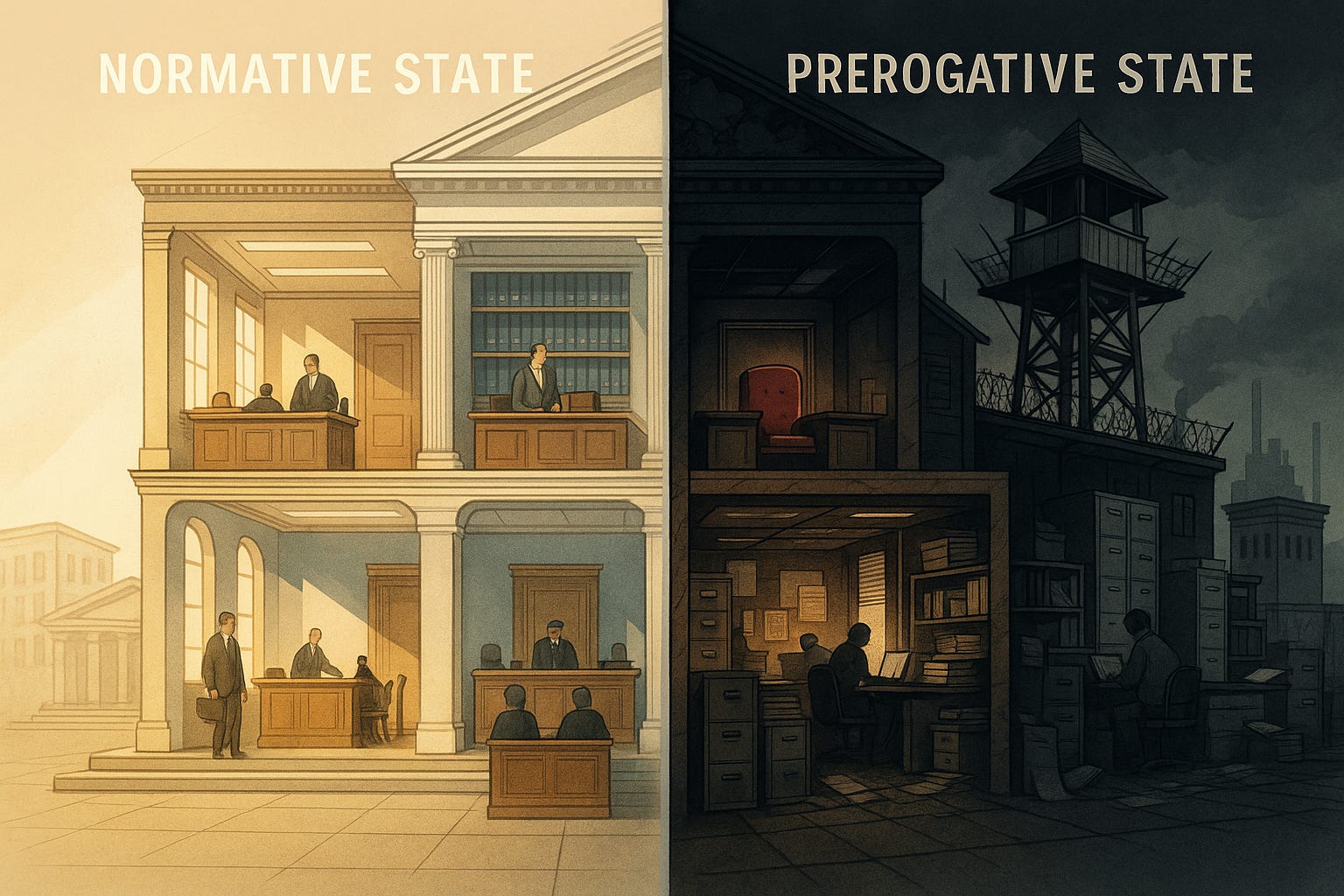
Fraenkel’s insight was that the Third Reich did not abolish the rule of law. It split governance into two parallel systems: the “normative state,” where bureaucratic rules and legal procedures continued to operate, and the “prerogative state,” where arbitrary power reigned. The innovation was not the triumph of one over the other. It was their simultaneous coexistence. Law where convenient. Will where necessary. For my friends, everything; for my enemies, the law.
I wrote about this six months ago, when the contours of what was coming were becoming clear. I did not fully understand then how quickly the dual state would manifest in blood.
Alex Pretti had a constitutional right to carry a firearm. He had a constitutional right to film public officials. He had a constitutional right to assemble, to protest, to bear witness. The normative state—the state of laws and rights and procedures—said he was a citizen exercising his liberties.
The prerogative state said he was an enemy, and enemies may be killed.
Stephen Miller articulated this theory explicitly: “When a federal agent issues a command in the field, he is acting as the direct avatar of the President. To refuse that command—to debate it, to delay it, to be ‘mouthy’—is not a civil liberty. It is an act of insurrection against the Executive Branch.”
The agent is the law. The badge conveys not merely authority but sovereignty. There is no such thing as an unlawful order, because the source of the order is the President, and the President is above the law.
As I wrote last week, this is the Führerprinzip—the “leader principle”—in American legalese.
In December, Attorney General Bondi issued an undercovered memo that operationalizes this principle at scale. The memo directs the FBI to compile lists of groups and individuals whose “animating principle is adherence” to disfavored viewpoints: opposition to immigration enforcement, “radical gender ideology,” anti-capitalism, “hostility towards traditional views on family, religion, and morality.”
These are not criminal acts. These are beliefs. And the memo creates a mechanism—through terrorism sentencing enhancements, through network mapping that includes “organizers, funders, and affiliates,” through the chilling effect of investigation itself—to punish those beliefs without ever having to prove a crime.
You don’t need a conviction to destroy a nonprofit. You just need to scare away its donors by suggesting it’s under investigation for terrorism. You don’t need to formally designate someone a domestic terrorist. You just need to put them on an internal list that triggers sentencing enhancements if they’re ever charged with anything else.
The prerogative state is being institutionalized. It is being given bureaucratic form. And it is being aimed, with specificity and intention, at anyone who dissents.
V. The Ratchet
Here is the thing that keeps me awake at night.
Garry Kasparov, who lived through the consolidation of Putin’s Russia, posted a brief note after Pretti’s killing: “Having lived through a similar, nationwide version of this in Trump’s model, Putin’s Russia, it’s not easy to fight against. And Trump and many of his gang have passed the point at which they feel they can afford to lose power, even in Congress. It’s a perilous moment.”
Once you have crossed certain lines, you cannot afford to lose power.
The agents who killed Renée Good and Alex Pretti are operating on a promise of impunity. That promise is only as good as Trump’s hold on power. A Democratic administration would have to investigate these killings. A Democratic DOJ would empanel grand juries. The agents who were promised immunity would discover that the promise was worthless.
Which means the regime cannot lose power. Not now. Not ever.
This is the ratchet. Each crime creates the need for the next crime. Each pardon requires the next pardon. Each killing deepens the commitment of the killers to the regime’s survival.
The January 6th pardons were not merely retrospective clemency. They were a prospective promise: violence committed in service of this president will be forgiven. That promise has now been extended to federal law enforcement. It will be extended further.
And the people who have accepted that promise—the agents, the officials, the collaborators—are now hostages. Their freedom depends on the regime’s continuation. They cannot permit it to fall.
Putin passed this point long ago. Every election in Russia since has been a formality, because the alternative to winning is prison or death. Trump is passing that point now. The killings in Minneapolis are not incidental to this process. They are the mechanism by which it advances.
VI. What Remains
The Trump regime is beyond shame. Every time it has been confronted with evidence of its own cruelty, it has doubled down. The traditional logic of nonviolent resistance—that exposing brutality to a watching world will delegitimize the brutalizers—does not function when the brutalizers treat exposure as an opportunity for dominance rather than a cause for retreat.
The only thing that has made Trump retreat, consistently, is an angry bond market. The prerogative state may be immune to moral suasion, but it still depends on the normative state’s financial infrastructure. The exorbitant privilege that lets America borrow cheaply depends on the world’s belief that we are governed by rules rather than whims. Every killing, every lie, every exercise of raw power chips away at that belief.
But we cannot wait for bond traders to save the republic. We cannot wait for anyone to save us.
We had our chance last November, and we failed the test.
What remains is this: we show up. We document. We refuse to submit to the assertion of power. We are beyond the point where we can put our heads down and hope they don’t come for us. That strategy—the strategy of the compliant, the strategy of the silent—has never worked in any authoritarian transition, and it will not work now.
They want you to be afraid. They want you to calculate the risks and decide that silence is safer. They want you to internalize the lesson they are teaching: this is what happens to mouthy people.
But silence is its own kind of bet. It is a bet on the world you fear most—a bet that submission will purchase safety, that if you just keep your head down, the regime will pass you by.
It won’t. It never does. The definition of “enemy” always expands. The list of prohibited beliefs always grows. The people who think they are safe because they are not immigrants, not activists, not protesters—they will discover, too late, that safety was always an illusion.
The country I grew up in is gone. I don’t say that with nostalgia for some golden age that never existed—I know the prerogative state has always operated in America, from Jim Crow to COINTELPRO to the border camps. But there was a normative consensus, however imperfectly honored, that these were violations of our ideals rather than expressions of them. That consensus is gone.
What comes next is up to us. The same as after the Civil War. The same as after the Depression and World War II and the civil rights movement. Those were revolutions in their own right—moments when the old order collapsed and something new had to be built from the wreckage.
Here we go again.
I don’t know what the new order will look like. I don’t know how much suffering we will put ourselves through to get to the position where we can rebuild. I don’t know if we will build something better or something worse. I don’t know if we will be permitted to build anything at all, or if the prerogative state will swallow everything.
But I know this: Alex Pretti went to a protest because he wanted to help. His last act was shielding a woman who had been knocked to the ground. He was bearing witness. He was being a citizen.
They killed him for it.
If that is the price of citizenship now—if bearing witness and helping your neighbor and exercising your rights can get you executed in the street—then we need to decide what we’re willing to pay. Because the alternative is not safety. The alternative is a slow suffocation, a gradual surrender of everything that made this country worth living in.
I choose to be mouthy. I choose to bear witness. I choose to say the thing that happened, clearly and without flinching, and to put it on the record.
Alex Pretti was murdered by federal agents who then fled the scene. The official statements are lies. The video shows what it shows.
I don’t know what comes next. But I know where I stand.
You?
These things were never entirely true in the United States. But they were truer here for more people, and more types of people, than they were most anywhere else in recorded history. That’s not nothing, despite our evident flaws.
I generally do not recommend watching things like this. An execution of a fellow citizen by the government charged with protecting us. Violence is hard to watch. Here, I do encourage you to watch it. It is important to really understand what’s happening. Here’s the NYTimes page on it. Here’s one of the full videos, from a disturbing vantage.
I’m weeping. I feel sick. Keep writing, Owen. Please keep writing.
So well written @Owen McGrann
Deserving of a much broader audience and real understanding of what exactly has emerged here. An extremely salient point: “The law applies differently depending on which category you occupy. For friends, the law is a shield. For enemies, it is a sword”
And thus, as it ever was. We have an expression in the UK amongst the plebs / the common folk: “The law is an ass.” We know it has been designed in such a way that enables the switch between the sword and the shield. Only, the extremes by which this is now playing out have widened significantly. A sobering thought on the descent into tyranny that has long been warned of.