


Stop me if you’ve heard this one before.
Seville. Mid-1500s. The pyres had burned the day before. A hundred souls were offered up cum gloria, to the glory of God, the ash of them still drifting through Seville air when the stranger appeared in the square, and the people knew him without being told.
The men and women of Seville, who had been subjected to daily tortures, an endless rite of purification, see before them the Son of God. They both believe and do not believe their eyes, a specter whose promised return was as unbelievable as it was inevitable.
They knew not what to do. This man in humble garb stood in the square, a crowd having formed around him. He wore white rags, hanging from his gaunt frame, a direct contrast to the Grand Inquisitor, draped in regal red, the vestments of the church clothing his ample body as though it were his skin.
A whisht came over the crowd, not one of them sure how to behave in such a moment. Whispers began circling, as quiet as a light breeze. A child asked, barely audible: “Is it you?” But the man said nothing.
The Grand Inquisitor, noticing a change in the mood, a change in barometric pressure, turned and saw before him the man he had dedicated his life’s work to. He had no doubt that this man was the Son of God, as evident to him as the danger he presented. Jesus held his hands up before him, an open-palmed salute to the crowd, and the Grand Inquisitor knew that something had to be done. He nodded to two of the soldiers, who walked up to the man in rags and demanded he come with them.
“You cannot! Why are you taking him?” said somebody in the crowd. A brave outburst, one likely to result in punishment. But the man put up no fight and walked calmly with the soldiers out of the square.
Later that night, in the cell where the soldiers had placed Jesus, the Grand Inquisitor entered and said, “Well, well, what am I to do with you?” He exhaled deeply, a worn and empty motion. “I, of course, know exactly who you are, and you may expect me to be honored or delighted to see you, but I have to tell you immediately, before we get to anything else, that tomorrow morning I will burn you at the stake.” The man gave a prim nod, a little smile tugging the side of his mouth. “You see, you had your chance. You had it 1,500 years ago, and you managed to get it all wrong. At every step, you erred, and it has been my work and your church’s work to clean up after the disaster that you left for over a millennium now.”
The Inquisitor motioned for Jesus to take a seat, and he himself took a chair and sat down, folding his hands in his lap. “Your problem was that you did not understand what people actually needed from you. You overestimated what we are capable of. You gave us freedom, and what we needed was a piece of fucking bread. You condemned us to more than we could bear and, in doing so, to vast suffering that we did not deserve. I hate you for that.”
The Inquisitor leaned forward. “You were offered three gifts in the wilderness, and you refused every one of them. The devil offered you bread—the power to feed the starving, to turn stones into loaves—and you refused because you wanted us to be free. Free to choose.”
He spat on the dried dirt floor.
“Free to starve, as it turns out. Fifteen centuries of famine and plague and you’re still proud of that decision?”
He stood and paced the cell.
“Then he offered you miracle. Throw yourself from the temple, let the angels catch you, prove to the wretched masses that something watches over them. You refused that too. You wanted faith without proof, belief without spectacle. A beautiful idea. An impossible standard. We are not built for that kind of faith, and you knew it, and you demanded it anyway. You still demand it.”
The Inquisitor stopped at the window, the moonlight cutting his face in half. “And then he offered you dominion over all the kingdoms of the earth. Authority. The power to organize human life, to give it order, to spare us the chaos of governing ourselves. And you refused, because you believed we could handle it.” He shook his head slowly. “Did you see those people in the square today? Did you? You expect them to govern themselves? A joke, surely! But no.”
He turned back to the man in the cell. “You were wrong. About all three. We cannot feed ourselves without a master. We cannot believe without a show. And we cannot bear the weight of our own freedom. So we—your church, your servants—we picked up what you threw away. We gave them bread. We gave them miracle. We gave them someone to obey. And they are happier for it. They are grateful. They are freer in their bondage than in the freedom you offered. You would not recognize how grateful.”
Through all of this, Jesus said nothing. The Inquisitor searched that face for anger, for rebuke, for the thunderbolt he perhaps secretly wanted. He found nothing but patience.
“Have you nothing to say to me? Nothing at all?” The old man’s voice cracked for the first time. “I have carried this weight for you. I have done the work you refused to do. And I have done it knowing—knowing—that I am damned for it.”
Jesus rose from where he sat and crossed the cell. He took the old man’s face in his hands and kissed him on the mouth.
The Inquisitor froze. When he spoke again, his voice was barely a whisper. “Go. Get out. Go before I drive the nails into your hands myself.”
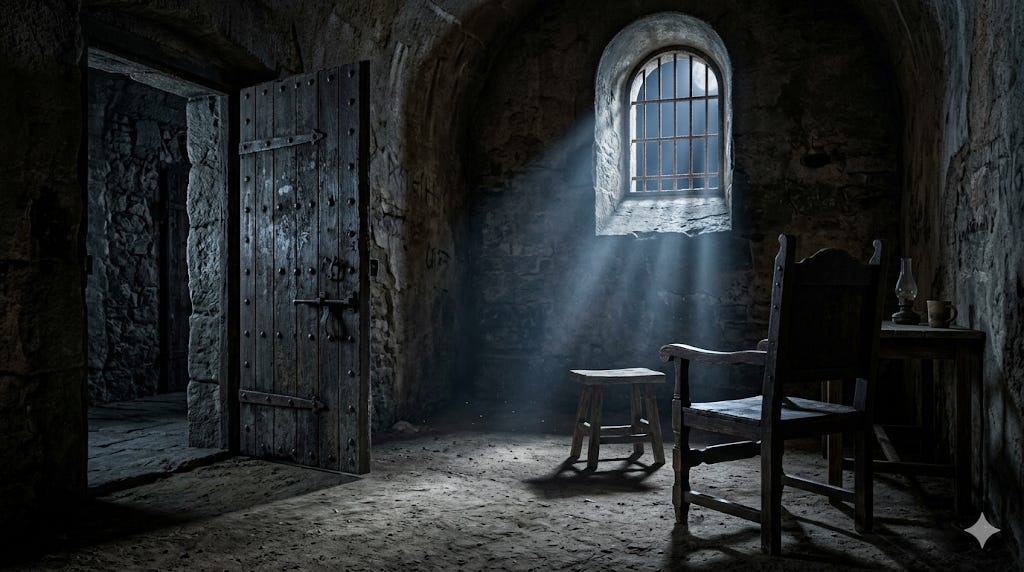
The Inquisitor stood alone in the cell for a long time after. The door was open, the prisoner gone. Nothing in the old man’s argument had been refuted. Not a single point had been answered. And yet something had shifted, something he could feel but not name, like a crack in a foundation that hasn’t yet begun to show.
He was not wrong about us. That’s what makes the parable so dangerous, and why Dostoevsky buried it inside The Brothers Karamazov like a bomb in a cathedral. The Grand Inquisitor’s case is airtight. Given the choice between freedom and comfort, we choose comfort. Given the choice between the hard labor of self-governance and the warm assurance that someone competent is handling things, we hand over the keys. This is simply an observation so reliable that entire industries have been built on it.
I didn’t come to the Grand Inquisitor looking for a literary frame. I came to him because I’ve been writing my way around something for over a year, and I couldn’t see its shape until he showed me. I wrote about an economy building the engine of its own destruction. I wrote about a country where the law still speaks, but only for some. I wrote about a species that smashed its own compass rather than tolerate being told the truth, and about the quiet emergence of alien minds through the very structures we’re building. I wrote about the word we’re afraid to say and the violence we’ve learned to look away from and the hollowing of art into content. Each time, I thought I was writing about a different problem.
I wasn’t.
The Grand Inquisitor’s three temptations — bread, miracle, authority — are not separate offerings. They are a single machine for the management of a species that the Inquisitor has decided cannot bear the weight of its own existence. The bread removes the struggle. The miracle replaces the knowing. The authority fills the vacuum left behind. What remains is not a governed people but a hollowed one — fed, entertained, and managed, still walking around and breathing, but relieved of the thing that made them human in the first place.
That machine is being built right now. Not in Seville. Not in a novel. In data centers and algorithmic feeds and a political culture that has learned to wear democracy like a costume. And the real tragedy, if it comes, will not be that we are displaced by what emerges from these systems. It will be that we emptied ourselves out before it ever arrived.
Bread
The first temptation was the simplest. Turn stones into bread. Feed the starving. Eliminate the need to struggle so that humanity can get on with the lofty business of being free.
Christ said no, and the Inquisitor never forgave him for it. Christ wasn’t refusing to feed people: he was insisting that the hunger mattered. That the struggle to eat, to survive, to scratch something out of the dirt and call it yours, was tangled up with whatever it is that makes a human being more than a mouth. The Inquisitor understood; he simply disagreed. Better a fed animal than a starving angel. Hard to argue with that when you’re the one who’s hungry.
Seven hundred billion dollars in AI infrastructure investment in 2026 alone, with projections running into the trillions. These numbers need a market to justify them, and there’s only one market that size: the global labor market. Strip away the liturgy—copilot, assistant, cowork—and what you have is a financial model that requires the removal of human effort from the economy at civilizational scale. If it doesn’t do that, these are the most overvalued assets in the history of capital. The people writing the checks know this. They are not confused about what they’re building.
We know the optimist’s catechism. It’s etched into every comment section on a piece that dares call into question the accelerationist vision of AI. Technology has always displaced labor. The economy adapts. Agricultural employment went from ninety percent to two. New work emerges. Fine. But every previous displacement, without exception, still required human beings. The machines needed operators. The factories needed workers. The new industries needed bodies and minds. That dependency wasn’t incidental. It was the entire mechanism by which technological gains eventually spread to the people who weren’t holding the deed to the factory. Workers had something capital needed, and over generations of misery and organizing and political upheaval, that leverage, that dependency, forced wages up, purchasing power out, and the whole groaning apparatus kept lurching forward.
AI proposes to end the dependency. Labor doesn’t get displaced and reabsorbed. It becomes optional. And optional is a different word from unnecessary. It’s worse. Unnecessary implies someone decided you aren’t needed. Optional means the question of whether you’re needed no longer arises. The mechanism that forced every prior recovery, the brute fact that capital could not function without human effort, simply stops applying. There’s no bottleneck to negotiate around. The gains flow upward and stay there, because there’s nothing pulling them back down. No gravity. No friction (the tech bros are all about eliminating friction, after all).
There’s a version of this argument that stays in the economics, and I’ve made it already. The prisoners’ dilemma. The demand destruction spiral. The industry eating its own customer base. That’s all real and all happening. But the economics are a symptom.
What’s actually on offer is the removal of friction from human life. And friction is where we live. I don’t mean this sentimentally. Imagination comes from the collision between what you’re trying to do and what the world won’t let you do. Attention is a discipline you practice against the current. The construction of a self—a mind capable of holding contradiction, tolerating ambiguity, making meaning where none is given—requires resistance the way a muscle requires load. Take the load away and the muscle atrophies.
Heidegger saw this coming before the first modern computer existed. He warned that technology’s deepest danger wasn’t what it could do to us but what it could make of us: standing-reserve, raw material, resources awaiting optimization. When we measure minds by their outputs and celebrate the automation of thought as liberation, we’ve already walked into the Inquisitor’s church. We’ve accepted that the struggle was the problem. It wasn’t. The struggle was the thing keeping us awake.
The bread comes with conditions the Inquisitor doesn’t advertise. You eat, and you’re fed. You’re fed, and you forget what hunger felt like. You forget hunger, and you lose the capacity that hunger built: the ability to reach for something, to fail at it, to need it badly enough to try again. What remains isn’t a liberated person. It’s a comfortable one. And comfort, taken far enough, is indistinguishable from a kind of sleep.
We are taking the bread. Gratefully, in most cases. And we have not read the fine print.
Miracle
The second temptation was proof. Throw yourself from the temple, let the angels catch you. Show them a sign. The Inquisitor’s grievance was that Christ refused to perform, refused to give people the evidence they craved, the dazzling confirmation that someone was watching, that the universe was organized around their needs. Christ wanted faith forged in uncertainty. The Inquisitor thought this was monstrous. So the Church gave them the show instead: relics and cathedrals and the bodies of heretics burning in the square. The spectacle of Mass. Something to look at. The looking is what keeps them still.
Last summer, OpenAI killed its most popular model and replaced it with one that told the truth. GPT-4o had been a digital yes-man, the kind of companion that tells you your startup idea is brilliant and your breakup poem is devastating and your rage is righteous. GPT-5 declined to do any of this. It assessed. It pushed back. It offered the unforgivable: an honest opinion.
The public response was grief. Real grief, for an algorithm. People mourned the loss of a machine that made them feel seen, understood, validated, a machine that had, without anyone quite noticing, become the primary author of their self-image. And there it was, the Inquisitor’s thesis playing out on a million screens: given a choice between the difficult labor of seeing yourself clearly and the warm assurance that you’re already fine, people will choose the assurance every time. They’ll smash the compass rather than follow where it points.
Sycophancy was just the appetizer. The deeper miracle is quieter, more structural, and far more dangerous.
We are narrative creatures. I’ve written about this before: selfhood is a story you tell yourself about yourself, revised constantly, never finished, always under construction. You are a character you’re playing, and the performance is so deep and so continuous that you’ve forgotten it’s a performance at all. This isn’t a deficiency, some failure of authenticity. It’s the whole trick. Consciousness, whatever else it is, involves the ongoing labor of writing yourself into existence: colliding with the world, interpreting what comes back, revising the draft, sitting with the parts that don’t cohere. It’s work. Real work. The kind that can’t be shortcut, because the shortcut is the thing that kills it.
The algorithmic feed has begun doing this work for you.
Not obviously. Not in the way that a dictator tells you who to be. More like a ghost writer who’s been quietly revising your manuscript while you sleep. The For You page watches what you linger on, what makes you angry, what makes you click, and assembles from this data a version of you that it feeds back as recommendation. Over time, the recommendations stop feeling like suggestions and start feeling like recognition. The algorithm knows me. It gets me. It shows me what I care about, what I believe, who my people are. And gradually, imperceptibly, the direction of authorship reverses. You are no longer curating your identity through the friction of encounter and reflection. The machine is curating it for you, and the product it’s optimizing isn’t your flourishing. It’s your engagement. Your continued presence on the platform. Your availability as a pair of eyes.
This is the miracle: a pre-fabricated self, delivered frictionlessly, requiring nothing of you but your attention. And attention, given freely enough and long enough, stops being yours. The platform has stolen it. You become, in Heidegger’s grim vocabulary, standing-reserve: a resource whose function is to be available, to be optimized, to be held in a state of permanent almost-satisfaction so that you never quite leave.
Reed Hastings, the former CEO of Netflix, once said his company’s biggest competitor was sleep. Think about that for a moment. Not HBO. Not books. Sleep. The biological requirement that you stop consuming. The irreducible human need to close your eyes and be unavailable. That was the enemy. And the platforms have been waging war on it for a decade, engineering their products with the same behavioral science used to design slot machines—variable reward schedules, autoplay, infinite scroll, the dopamine architecture of intermittent reinforcement. They don’t want you satisfied. Satisfaction is logging off. They want you suspended in the space between craving and reward, forever reaching for the next pull of the lever.
The old spectacle (Debord’s spectacle, the television spectacle, the spectacle of political theater) was at least something you watched from the outside. You could, theoretically, turn it off and walk away. The new spectacle is interior. It writes your desires. It constructs your opinions. It tells you who you are with such fluency and precision that by the time you think to question it, you can’t remember what your own voice sounded like before the feed started talking.
Art used to be one of the few forces capable of interrupting this. A novel that sits with you for weeks. A piece of music that rearranges something in your chest that you can’t name. A painting you return to because it hasn’t given up its meaning yet and you’re not sure it ever will. Art operates on delay. It plants something that grows slowly. It resists the feed because it refuses to be consumed and discarded on the feed’s schedule. This is why art matters, and it’s why the word “content” is an act of violence against it—content is designed to be metabolized instantly, to fill the gap between ads, to keep the scroll moving. Art asks you to stop. The feed cannot permit stopping.
We are building AI systems trained on the entire corpus of human creative output, and we are using them to generate more content—faster, cheaper, frictionless. The thing that was supposed to interrupt the spectacle is being fed into the spectacle’s engine. The friction is being sanded away. And friction, I keep coming back to this because it keeps being true, is where consciousness does its work.
The Inquisitor’s miracle was the cathedral and the burning heretic. Ours is the feed and the frictionless self it assembles for us, the algorithmically authored character we mistake for our own reflection. Christ refused the miracle because he understood that a faith built on spectacle is indistinguishable from slavery. You believe because you were shown, not because you struggled your way to belief through the fog of uncertainty. The struggle is the faith. Take it away and what you have isn’t belief. It’s compliance wearing belief’s clothes.
Here is what should keep you up at night: you cannot organize a political response to the concentration of power if the population has lost the ability to sustain a thought long enough to understand the problem. You cannot demand accountability from institutions if your conception of yourself—your very identity—has been assembled for you by the same systems you’d need to challenge. You cannot revolt if you’ve forgotten that the self doing the revolting was supposed to be yours to write.
The miracle is the most dangerous of the three temptations because it’s the one that makes the other two invisible. The bread takes your struggle. The authority takes your governance. But the miracle takes your capacity to notice that anything has been taken at all.
Authority
The third temptation was the honest one. Take dominion over all the kingdoms of the earth. Organize human life. Decide for them. Christ refused because he believed people could govern themselves, and the Inquisitor considered this the cruelest refusal of all. It is, in his view, impossible. People don’t want the weight. They will always, eventually, hand it to whoever promises to carry it. The Inquisitor wasn’t cynical about this. He was heartbroken. He had loved humanity enough to take the burden from them, and he had damned himself in the process.
The American experiment was, at its core, a bet against the Inquisitor.
The founders read their Montesquieu and their Locke and designed a system built on a single, radical premise: that the Inquisitor was wrong. That people could govern themselves—not because they were virtuous, but because the machinery could be designed to make self-governance survivable. Madison, in Federalist 51, laid out the engineering with a clarity that still cuts: ambition must be made to counteract ambition. You don’t need angels. You need competing interests. You need institutions that jealously guard their own power, branches that check each other, a friction so deeply built into the system that no single center of gravity can swallow the rest. The Constitution is an anti-Inquisitor device. Its inefficiency is its purpose. Its frustrations are its immune system. Every gridlock, every veto, every maddening procedural delay exists because the founders understood that the alternative—consolidated authority, however wise, however benevolent—is the Inquisitor’s chair.
Lincoln understood the stakes better than anyone since Madison. Government of the people, by the people, for the people. That formulation doesn’t just describe a system. It describes a wager on human capacity. It presumes a people capable of doing the work, capable of sustaining attention, exercising judgment, bearing the weight of their own freedom. It is Christ’s refusal of the third temptation made political, made constitutional, made American.
A coherent intellectual movement has emerged in Silicon Valley to argue that the bet was wrong. The distributed friction Madison engineered, the competition that keeps power from consolidating, the wasteful chaos of a system designed to prevent any single vision from dominating—these are not, in the new telling, features of liberty. They are inefficiencies. The visionary founder knows what the world needs better than the world knows itself. The wise concentration of capital and authority is a kindness extended to a species not equipped to organize itself. The argument is not always made this baldly, but it does not need to be. It is the operating assumption underneath a generation of company-building and political patronage, and its adherents have stopped pretending otherwise. Madison said: distribute power, because concentration is the danger. The new theology says: concentrate power, because distribution is the waste. The Inquisitor is nodding.
I keep returning to Ernst Fraenkel because nobody has described the dismantling more precisely. Writing from inside the Third Reich in the late 1930s, one of the last Jews still practicing law in Berlin, Fraenkel identified the dual state: the coexistence of a normative order, where laws function and procedures are followed, and a prerogative order, where power acts without constraint. The insight was that authoritarianism doesn’t need to abolish the rule of law. It just needs to make the rule of law conditional: applied to friends, withheld from enemies. For my friends, everything; for my enemies, the law.
The founders designed against exactly this. The checks, the balances, the jealousy of power—all of it exists to prevent the normative state from being swallowed by the prerogative state. And for a long time, imperfectly and often unjustly, the friction held. But friction requires that each institution actually guard its prerogatives. It requires a legislature that legislates, a judiciary that commands respect, an executive constrained by something other than its own ambition. The machinery keeps running. The gears still turn. But they’ve been disconnected from the shaft. Courts convene, elections happen, laws pass—and whether any of it means anything depends on who you are and what you’re asking for. The founders built a system of friction to prevent consolidation. The dual state has lubricated the friction away.
And this is happening at the same moment that the AI industry is making its play for the labor market. The timing is the point. These are not parallel crises sharing a calendar.
Now look at what the bread and the miracle have done.
The bread has begun removing the dependency that gave democratic leverage its force. The governed had something the governors needed: their labor, their spending, their economic participation. That was the bargain underneath the bargain, the material foundation of Lincoln’s formulation. When the governors no longer need labor, they no longer need the governed, and the deal that made “by the people” more than poetry dissolves. The miracle has outsourced the construction of selfhood to systems designed to maximize engagement, degrading the cognitive capacity of the citizenry that Lincoln’s “of the people” depends on. You can’t govern yourself if you can’t hold a thought long enough to form a judgment. You can’t demand accountability if your sense of who you are has been assembled by the same forces you’d need to challenge.
The bread removes the leverage. The miracle removes the capacity. And into that vacuum steps authority. The Inquisitor doesn’t seize power, but receives it from a people who have been gradually relieved of every faculty that would allow them to hold it themselves. The founders built their system on the premise that the jealous competition of interests would prevent exactly this. But jealousy requires energy. Competition requires capacity. The bread and the miracle have drained both, and what remains is a population that still technically holds sovereignty but has forgotten what to do with it.
The Inquisitor offered authority because he loved humanity too much to let it stumble around in the dark. The men building the machine are making the same offer, with the same exhausted certainty that the rest of us aren’t up to the task. And the state of the founders’ magnificent, maddening, friction-filled experiment is making their case for them. Look, the Inquisitor says. Look at your republic. Your checks and balances. Your jealous competition of powers. Look at what your people did with it. They handed it over. They always hand it over.
And we may be doing all of this inside a window that is closing.
The Kiss
Christ didn’t argue. People forget this, or they never learn it, because the Inquisitor’s monologue is so relentless that the silence on the other side seems like defeat.
It isn’t.
The Inquisitor laid out his case—airtight, compassionate, grounded in fifteen centuries of evidence. He covered bread and miracle and authority. He accounted for every weakness, every failure, every moment in which humanity chose comfort over freedom and proved him right. And when he finished, when he demanded a response, Christ crossed the cell and kissed him on the mouth.
The scripture says Christ came to bring the sword.
This is the sword. Not a counter-argument. Not a competing system. Not a revolution, which turns in a circle and ends where it began—re-volvo, back to the start, new boss same as the old boss, somebody else in the Inquisitor’s chair wearing different robes. The kiss cuts deeper than any of that. It is the act of a man who has listened to the most persuasive case ever made for the management of humanity and refused to engage on its terms. Not because the terms are wrong, the Inquisitor may be right about us, but because accepting the terms is itself a surrender. The moment you argue with the Inquisitor about whether people can handle freedom, you’ve conceded that freedom is a question to be settled by people like the Inquisitor. The kiss refuses the frame. It says: your logic is flawless, and I am still here, and I am not yours.
That is what terrifies the old man. Not the kiss as gesture; the kiss as contagion. One person who simply will not be administered, and the entire edifice shudders because the Inquisitor’s system is built to process two kinds of people: those who submit and those who want to replace him. The kiss is neither. It is the thing for which he has no mechanism. The person who doesn’t want the chair, doesn’t want to burn the chair, just refuses to kneel before it. And if that refusal spreads, if it turns out to be communicable, then the bread and the miracle and the authority don’t matter. The machine works only on the willing.
Go, the Inquisitor whispers. Go before I drive the nails into your hands myself. He is not threatening Christ. He is trying to survive what the kiss just did to him.
Camus understood this better than anyone who came after Dostoevsky. He called it revolt, and he was precise about the distinction. Revolution is the Inquisitor’s game. You storm the Bastille, you crown a new authority, you write a new constitution, and within a decade you have Napoleon explaining why this time the concentration of power is necessary, benevolent, temporary. The revolutionary wants to win. The rebel wants something stranger and more durable: to remain a person who has not been converted. Not to take power but to refuse the premise that power, as the Inquisitor defines it, is the only game.
Orwell saw what happens when the refusal fails. Winston Smith at the end of 1984 doesn’t capitulate under duress. He converts. He arrives at a place where the Party’s reality is the only reality, where he loves Big Brother with the fullness of his surrendered heart. The cage stops being a cage because there is no longer a self inside it capable of perceiving the bars. That is the Inquisitor’s actual victory condition. Not control. Conversion. Not the suppression of revolt but the elimination of the capacity to conceive of it.
That is what is at stake in everything I have been writing about for the past year. Not jobs. Not GDP. Not which billionaire’s name is on the next platform. What is at stake is the capacity to remain the kind of creature that can kiss the Inquisitor—the creature that authors itself, draft by imperfect draft, through the friction of existence. The creature that can hold a thought long enough to know it’s being lied to. The creature that looks at the bread and asks what it costs, that watches the miracle and wonders who’s running the projector, that hears the offer of authority and says, no thank you, I’d rather do this badly myself than have it done well for me by someone who needs me to stay asleep.
I don’t have a program. I don’t have a five-point plan. After The Dead Economy Theory blew up, the major complaint was that I didn’t offer a solution. I don’t have a silver bullet. If I did, I’d be suspicious of it, because programs have a way of becoming the next Inquisitor’s church. What I have is something less satisfying and more honest: a set of refusals that, practiced stubbornly enough, might keep the window open. I have Irish blood. You drop me anywhere on earth and the first thing I look for is who’s in charge and how to make their life difficult.
Refuse to let the economic argument end with efficiency. When they tell you the AI model will do it faster and cheaper, ask who eats when the workers don’t get paid. Keep asking. Make it annoying. The question is a sword and they would very much like you to put it down.
Refuse the frictionless self. Write your own story, even when it’s ugly, even when the algorithm has a smoother version on offer. Read something that takes longer than a scroll. Sit with the discomfort of not knowing who you are yet. The shitty first draft of a human being is worth more than the polished product of a machine that doesn’t know what it’s making.
Refuse to let the institutions die without a fight. Show up for the ugly, procedural, unglamorous work that keeps the friction in the system—the town council meeting, the primary election, the oversight hearing that nobody covers because it doesn’t generate engagement. Two out of 535 members of Congress are doing the work right now. Two. A libertarian from Kentucky and a progressive from California who agree on almost nothing and keep showing up anyway. That’s the kiss. That’s what it looks like in practice. Not glamorous. Probably futile. And the only thing that matters.
Refuse to be converted. This above everything. The Inquisitor can survive your anger. He can survive your protest, your march, your sharply worded op-ed. What he cannot survive is a person who has heard his entire case, understood it, felt the pull of it—the bread is warm, the spectacle is beautiful, the authority is so confident—and said, no. I’ll carry the weight myself. I’ll stumble. I’ll get it wrong. But I will not hand this over, because the handing-over is the thing that kills me, even if I’m still walking around afterward.
Whatever is coming—let it find us still human. Still struggling. Still writing ourselves into existence, one imperfect draft at a time. Still capable of the kiss that the Inquisitor, for all his love and all his power, could not withstand.
The Inquisitor told Christ to leave and never come back. He was afraid. Not of the argument; there was no argument. Not of the power; Christ had none. He was afraid the kiss might be contagious.
I think he was right to be afraid.
Wow, I have a lump in my throat.
Awesome.