



If a political party does not have its foundation in the determination to advance a cause that is right and that is moral, then it is not a political party; it is merely a conspiracy to seize power.
Dwight Eisenhower
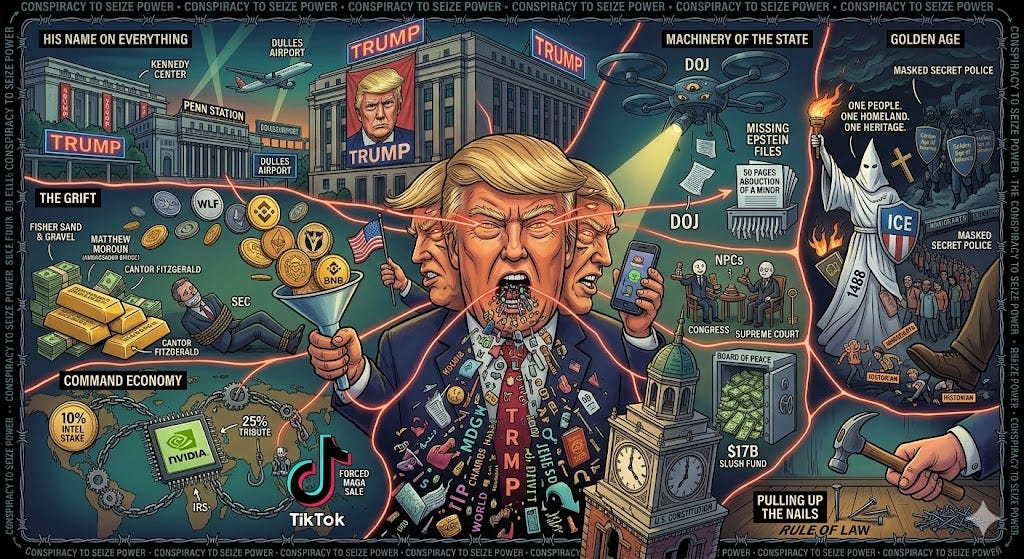
A defining sensation of the Trump era, for me, is the sensation of overwhelm. Part of the reason I write about any of this is that I feel muddle-headed and the writing forces me to think it through. But every time I sit down to write, I have to whittle down what’s bouncing around in my brain because there is so much happening, I would have to write a book to cover it all. Or a series of books. And I don’t have time for that shit.
The problem is that by narrowing the topic to a newsletter-sized morsel, the connections between things get muted. I wrote about the pathetic obeisance of law firms in one piece, followed by an exploration of how the rule of law decays in authoritarian takeovers, then pivoted to the escalatory measures taken by masked secret police. I got out over my skis into economics. I have been wanting to write about the state-run command economy being introduced, and last night I began planning a piece about the DoD’s raging battle to bring AI companies to heel. But then I woke up at 4:00 am—sleeping with baby monitors means not ever really sleeping—and saw that we’d opened a war with Iran without the President so much as notifying Congress, and sat down to write about that instead.
Thing is, all of these are the same story.
All of these are manifestations of the same personalization of the government, the same cowardice from Congress, the same drive to make all the decisions, to be everywhere, to render all of the rest of us, in Gen Z parlance, NPCs.
So I’m going to try something different. I am not going to narrow the topic this time. I am going to try to hold the whole bloody thing in my hands at once and describe what I see, because I think that the serial treatment—this week’s outrage, next week’s atrocity—has been doing us a disservice. The sheer volume is not incidental to what is happening. The sheer volume is the method. And the only way to see the shape of a thing this large is to step far enough back that the whole of it comes into view, however sickening the panorama.
His Name On Everything
Let’s start with something that seems almost petty, because it is almost petty, and because the pettiness is revealing.
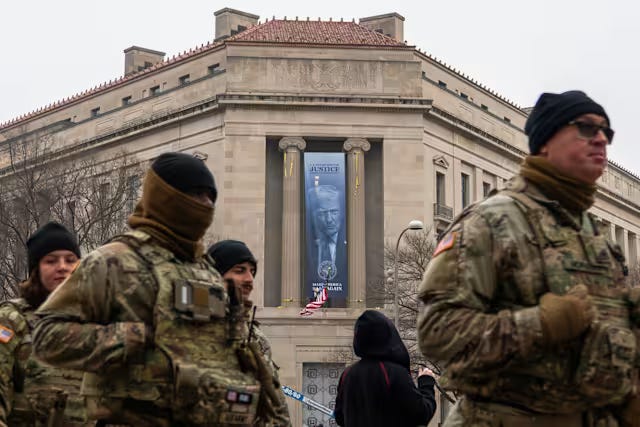
Donald Trump has put his name on the Kennedy Center. He has renamed the U.S. Institute of Peace after himself, while simultaneously suing to dismantle the organization; a federal judge ruled the dismantling illegal, which has not slowed things down. He offered to fund Penn Station’s renovation on the condition it be renamed after him. The same deal was offered for Dulles Airport. Florida has already passed legislation renaming Palm Beach International Airport in his honor. And he hung a banner of his own glowering face on the headquarters of the Department of Justice. The Department of Justice. The place that is supposed to embody the principle that no man is above the law now has one man’s face covering the façade like a campaign billboard, or a Soviet mural, or the side of a casino.
This is vanity, yes. The man is a grotesque narcissist; this is well-established. But the naming is doing something more than flattering his ego. Every authoritarian in history understands the function of putting your name and face on public buildings. It is a claim of ownership. It says: this institution is mine now. The Department of Justice is not yours, citizen. It is not the people’s. It is his. The name on the building is the flag planted in conquered soil.
Every public square in the Soviet Union had its statue. Every government building in Saddam’s Iraq bore his portrait. The function is always the same. You walk past it every day, and every day it tells you who is in charge, and after a while you stop noticing, and that is when it has worked.
The Grift
Anne Applebaum, whose work tracking kleptocracies has become essential reading, has been maintaining a Kleptocracy Tracker at Johns Hopkins that catalogs the financial conflicts of interest in this administration. The list is so long it requires its own website. I commend it to you. What follows is a partial survey.
The sons of Donald Trump, Commerce Secretary Howard Lutnick, and Special Envoy Steve Witkoff have built cryptocurrency empires worth hundreds of millions of dollars, almost certainly billions, buoyed, let us not be coy about this, by their fathers’ positions in the United States government. World Liberty Financial is a crypto venture co-founded by the Trump family and the Witkoff family. Lutnick’s twenty-eight-year-old son Brandon, now running Cantor Fitzgerald, served as its lead investment bank. The SEC has been dismissing cases against crypto exchanges run by major Trump donors—the Winklevoss twins, who donated over $21 million to pro-Trump PACs and are founding members of a private club partly owned by Donald Trump Jr., saw their Gemini lawsuit quietly dropped. Trump pardoned Changpeng Zhao, the founder of Binance, who had pleaded guilty to enabling money laundering and served four months in prison. Zhao promptly showed up at Mar-a-Lago to promote World Liberty Financial. The pardoning of a convicted financial criminal so that he can join your family’s crypto business is something that would get you laughed out of a spy novel for being too on the nose.
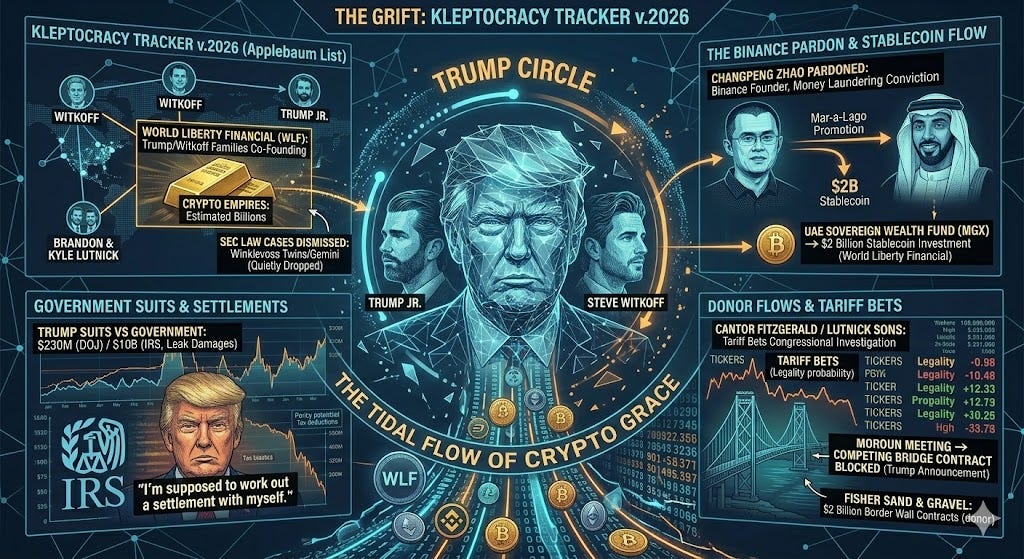
Applebaum has pointed out that crypto is an especially potent vehicle for corruption because investment can be anonymous. You can funnel money to the President of the United States and nobody will ever know. This is a bribery machine with the serial numbers filed off, operating in broad daylight.
And it goes on. The Board of Peace, a new international body Trump created and chairs, commands $17 billion in commitments ($10 billion from U.S. taxpayers, the rest from other nations) and Trump alone controls appointments, dismissals, agendas, and resolutions. Congress has not authorized where the $10 billion comes from. It is, as The Conversation put it, a privatized UN with one shareholder. The only way for Trump to lose his seat as head of the Board of Peace? He dies.
Trump has filed administrative claims seeking $230 million from the DOJ for alleged damages from investigations into his conduct. He has also sued the IRS for $10 billion, roughly two-thirds of the agency’s entire annual budget, over the leak of his tax returns. When asked about the obvious problem of a President suing a government he controls, Trump told supporters: “I’m supposed to work out a settlement with myself.” He has floated donating the proceeds to charity, which would, of course, also give him a tax deduction on a ten-billion-dollar settlement he approved for himself. (I also note that he controls many non-profits that function as his piggy bank.) Former DOJ lawyers, conservative and liberal alike, have urged the court to reject the claim.
When Lutnick became Commerce Secretary, he transferred his equity in Cantor Fitzgerald to a trust benefiting his adult sons, tax-free, as permitted by government ethics rules. Brandon, twenty-eight, became chairman. Kyle became executive vice chairman. The Commerce Secretary’s sons now run a major financial firm that is under congressional investigation by Senators Wyden and Warren for possible conflicts of interest related to tariff bets—bets on the legality of tariffs that their father, as Commerce Secretary, helped design. Matthew Moroun, the billionaire owner of the Ambassador Bridge between the U.S. and Canada, donated $1 million to MAGA Inc. on January 16th, met with Commerce Secretary Lutnick hours later, and less than a day after that, Trump announced he would “not allow” a competing bridge to open. Fisher Sand & Gravel, run by a reliable Republican donor, has received roughly $2 billion in border wall contracts.
Two billion dollars. To one donor’s company. For a wall.
I could keep going. I will not keep going because if I list every instance of graft in this administration we will be here all week and I have a toddler to feed. But sit with the weight of what I’ve just described, because that is only the financial dimension, and the financial dimension is only one face of this thing.
The Command Economy
There is a word for an economic system in which the government dictates which companies can operate, who they must sell to, who they cannot sell to, what share of their revenue belongs to the state, and which political allies get to buy the remains. That word is not “capitalism.” That word is not “free market.” The Republican Party, which has spent fifty years telling us that the invisible hand of the market is the closest thing to God’s hand on earth, has built a command economy in under a year.
Trump forced the sale of TikTok to a consortium of political allies — Larry Ellison, Rupert and Lachlan Murdoch, Michael Dell — signing the executive order with the words “If I could make it 100% MAGA, I would.” The federal government took a ten percent stake in Intel, purchasing $8.9 billion worth of common stock — the government literally owns part of a semiconductor company now, which is the sort of thing Republicans used to accuse Venezuela of doing. NVIDIA pays twenty-five percent of its Chinese revenue to the federal government as the cost of being allowed to sell there. The word “tribute” is appropriate. The word “tax” does not do it justice.
Then there is U.S. Steel. Trump blocked Nippon Steel's $14.1 billion acquisition, then reversed himself and approved it on one condition: the United States government, meaning Trump personally, would receive a "golden share" granting veto power over the company's hiring, capital spending, plant closures, headquarters location, and acquisitions, through 2035. He appointed Commerce Department officials to the board. The Atlantic Council asked openly whether Trump had effectively nationalized the company. When U.S. Steel tried to shut down a plant in Granite City, Illinois, Commerce Secretary Lutnick called the CEO and told him he wouldn't allow it. The President of the United States now exercises operational control over a private steel company. The United Steelworkers' president said Trump had assumed "a startling degree of personal power over a corporation." He didn't demand a cash cut. He demanded something more valuable: control.
And then there is the media consolidation, which continued this week. Netflix bid $83 billion to acquire Warner Bros. Discovery. The DOJ’s antitrust division launched a formal review of Netflix’s bid, issuing a second request for information that paused the deal. This was notable in part because the DOJ’s antitrust chief, Gail Slater, had just been removed by senior Trump officials. Into the breach stepped David Ellison—son of Larry Ellison, Trump’s ally, whose Paramount Skydance had already absorbed CBS after a merger prefaced by a $16 million settlement to Trump over his lawsuit against CBS News. Ellison bid $111 billion for all of WBD. Netflix CEO Ted Sarandos visited the White House, met with Trump’s staff, and then walked away. Netflix said the price was too high. Draw your own conclusions about what was discussed.
If the Paramount deal closes, one family (the Ellisons, bankrollers of the President) will control Warner Bros., HBO, CNN, CBS, Paramount, the Discovery channels, and a major stake in TikTok. David Dayen, writing in the American Prospect, described it as media consolidation with echoes of what we see in dictatorships. Elizabeth Warren called it “an antitrust disaster” in which “a handful of Trump-aligned billionaires are trying to seize control of what you watch.” Trump, for his part, publicly signaled he favored the Ellison deal, then walked it back and said he’d leave it to the Justice Department—the same Justice Department whose antitrust chief he’d just removed.
And then there is the deal that ties it all together, the one that reveals the machine in full. I am going to walk through it step by step because it is important that you understand how the pieces connect.
Start here: Trump’s special envoy for the Middle East is Steve Witkoff. Witkoff’s son Zach co-founded World Liberty Financial, the Trump family’s crypto venture. In May 2025, an Abu Dhabi state-backed fund called MGX, controlled by Sheikh Tahnoon bin Zayed Al Nahyan, invested $2 billion in World Liberty Financial’s stablecoin. Two billion dollars from a UAE sovereign wealth fund into the President’s family crypto business.
Two weeks later, Trump approved the sale of advanced American AI chips to the UAE, chips that had been restricted for national security reasons. Many of those chips were destined for G42, an AI company also controlled by Sheikh Tahnoon. The same man who sent $2 billion to the President’s family business received, shortly thereafter, access to restricted military-adjacent technology. The deal was shepherded through by Steve Witkoff, the envoy whose son’s company had just received the $2 billion.
The State Department Inspector General is now evaluating an ethics investigation. We shall see how long it takes to shut down that investigation.
Meanwhile, China can buy NVIDIA’s advanced H200 chips too, and the chain of causation there runs through the same cast of characters. Trump pardoned Changpeng Zhao, the Binance founder, in October. Binance subsequently deployed engineers and resources to boost World Liberty Financial’s market cap from $127 million to $2.1 billion. The UAE, whose sovereign wealth fund had already invested in World Liberty Financial, brokered expanded chip sales. National security restrictions on advanced semiconductor exports were relaxed for countries whose money flows through the President’s business ventures.
To get a sense of the insanity of this, I started putting this together and then kinda gave up:
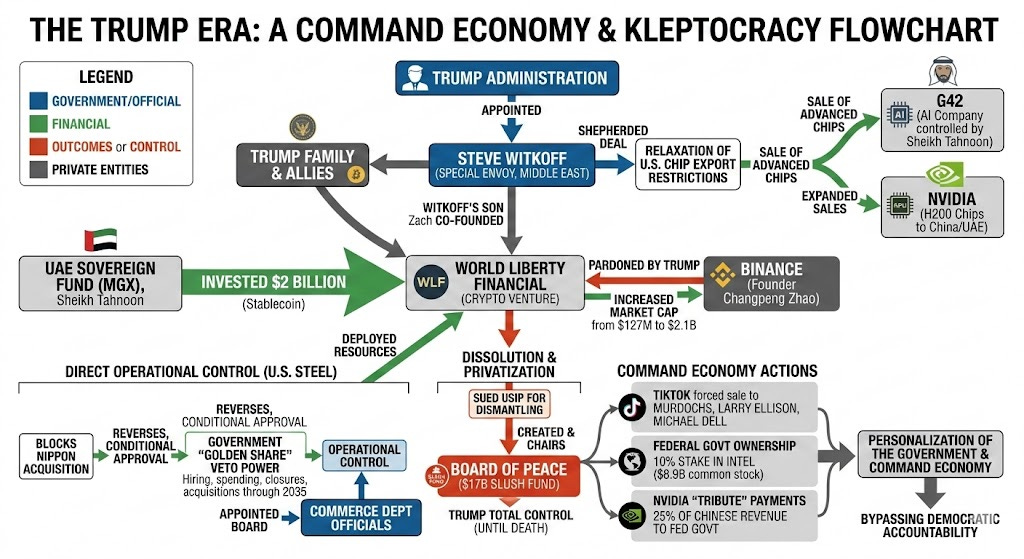
This is the sort of arrangement that the United States used to sanction other countries for. This is the sort of corruption we used to write sternly-worded reports about when it happened in Kazakhstan.
The Machinery of the State
A man who wants to steal has to first get rid of the people whose job is to stop stealing.
The Consumer Financial Protection Bureau has been gutted. OMB Director Russell Vought ordered it to cease operations in February 2025, and 88% of its workforce received layoff notices. The head of the Office of Government Ethics was fired. The head of the Office of Special Counsel was fired. The IRS budget has been cut by over twenty percent, its workforce slashed by a quarter, and the division that audits billionaires lost 38% of its employees. Over $800 million in DOJ grants have been terminated. Enforcement of the Foreign Corrupt Practices Act—the law that punishes American companies for bribing foreign governments—has been suspended by executive order, the first time since the statute was enacted in 1977. Enforcement of the Corporate Transparency Act has been halted for domestic entities. Every single institution whose purpose is to detect, investigate, or punish corruption has been defunded, decapitated, or mothballed.
And $15 million in USAID funds, money appropriated by Congress for foreign aid, was redirected to pay for Russell Vought’s personal security detail. The man who gutted the CFPB now has U.S. Marshals protecting him on the taxpayer’s dime, through an agency he helped dismantle.
Please don’t mistake this for deregulation. Deregulation is a policy preference about the appropriate scope of government. This is a man disconnecting the alarm system before he robs the house.
And it goes beyond the financial watchdogs. This morning, I woke up and learned with the rest of the world that the United States and Israel had conducted the most sweeping American military operation in the Middle East since the invasion of Iraq. They killed the Supreme Leader of Iran. Congress was not consulted. Not “Congress wasn’t given formal authorization.” Congress was not told it was happening. The Declare War Clause of the Constitution, which vests the power to make war in the legislature, has been treated as a suggestion for decades, by Presidents of both parties, and I have written about this before. But there is a difference between the slow erosion of a constitutional norm and a President launching the largest military campaign in twenty years without telling anyone. Congress found out from the news. The body that is constitutionally charged with deciding whether America goes to war learned about a new war the same way you did: on their phones.
The administration has sued over twenty states that refused to turn over their voter rolls. At least ten states have complied, handing over data on 37 million voters, including driver’s license numbers and partial Social Security numbers. The DOJ plans to analyze the data and instruct states to remove specific voters, something the federal government has never done. If you control who votes, you control who wins. If you control who wins, everything else is theater. I ask you: are Trump and his acolytes acting as if they will ever face consequences? Reckon with what that means.
There is one more thing, and it is different in kind from everything I have listed so far.
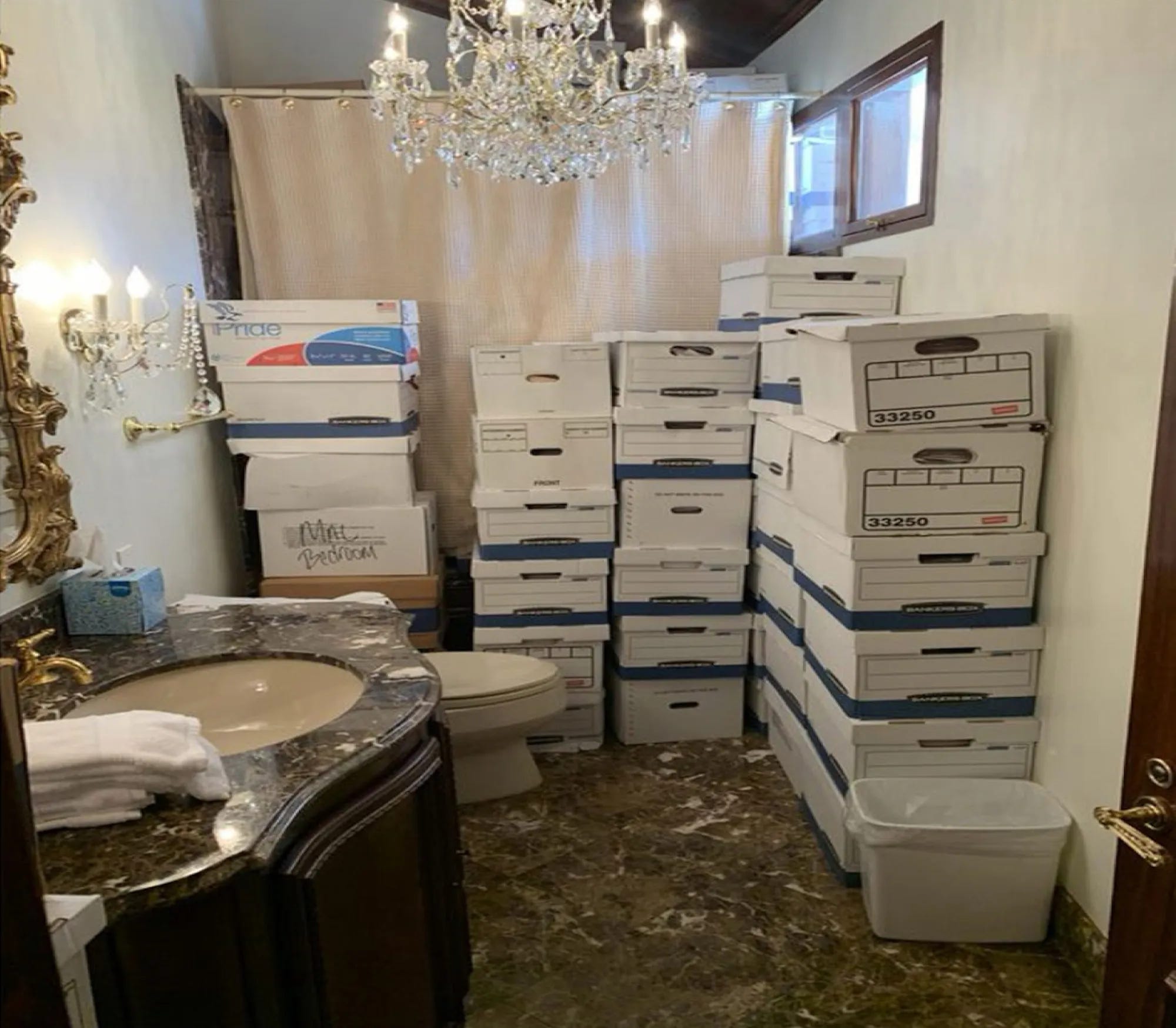
In November, Trump signed the Epstein Files Transparency Act, which Congress passed 427 to 1. The DOJ was required to release all files related to the Jeffrey Epstein investigation. By January 30, they had published 3.5 million pages. Trump is mentioned over 38,000 times in those documents. Then, on February 24, NPR reported that the public database was missing dozens of pages related to accusations that Trump sexually abused a minor. More than fifty pages of FBI interviews with the accuser. Gone. Not redacted. Not withheld with explanation. Simply absent. The DOJ declined to explain why. The White House said Trump had been “totally exonerated.” Even James Comer, a Republican, announced the Oversight Committee would investigate.
The Department of Justice—the one with the seventy-foot banner of his face on its headquarters—is the same department that disappeared FBI files about the President and a child. The apparatus of self-enrichment and the apparatus of self-protection are the same apparatus. The man who fired the ethics officials and gutted the watchdogs and suspended the anti-bribery laws has also, it appears, arranged for certain files to go missing. Files about a child.
And through all of it, Congress does nothing. The most powerful legislature in the history of the world has become a rubber stamp with a cloakroom. They will not assert the war power. They will not assert the power of the purse. They will not conduct oversight. They will not do their jobs. The President acts, and Congress watches, and the rest of us watch Congress watching, and the loop closes.
The Golden Age
Underneath all of the grift and the power-grabbing, there is an ideology, or something that functions like one. Let’s be specific about what it is, because “white Christian nationalism” is a phrase that has been thrown around so loosely it has started to lose its edges. So let me show you what I mean.
In the summer of 2025, as DHS ramped up hiring for 10,000 new ICE agents, the department’s official social media accounts began posting recruitment content that the Southern Poverty Law Center and multiple historians identified as white nationalist propaganda. Not content that might, if you squinted, be interpreted that way. Content that used specific, recognizable signals from the white supremacist movement.
In July, DHS posted an image of the 1872 painting American Progress, a work depicting white settlers conquering Indigenous land that is a staple of “great replacement” circles, with the caption: “A Heritage to be proud of, a Homeland worth Defending.” The caption contains exactly fourteen words. Fourteen words is the length of the most widely known white supremacist slogan in the world, coined by David Lane, a man sentenced to 190 years in prison for his role in the assassination of a Jewish talk show host. The caption capitalizes Heritage and Homeland — H and H, or 8 and 8, the numerical shorthand for “Heil Hitler.” Together, 14 and 88 form 1488, a number so foundational to neo-Nazi culture that the Anti-Defamation League maintains a dedicated page explaining it.
In August, DHS posted a drawing of Uncle Sam at a crossroads with the caption “Which way, American man?” — language drawn from Which Way Western Man?, a 1978 book by white nationalist William Gayley Simpson that was published by a neo-Nazi press, argues Hitler was right, and advocates violence against Jews. Mother Jones traced the original graphic to an account called “Mr. Robert” whose bio highlights the phrase “Wake Up White Man.”
In October, DHS posted a recruitment video captioned “End of the Dark Age, beginning of the Golden Age” with footage of heavily armed agents detaining protesters. The video used a song (“Little Dark Age” by MGMT) that had become an anthem among neo-Nazi and fashwave creators, set to the glitchy visual aesthetic of fascist internet subculture. In January 2026, two days after an ICE agent fatally shot Renee Good in Minneapolis, DHS posted another recruitment video featuring “We’ll Have Our Home Again” by Pine Tree Riots, a song popular in neo-Nazi spaces, with lyrics about reclaiming “our home” by “blood or sweat.” Members of Congress demanded that Meta stop running the ad on Facebook and Instagram.
In January 2026, the Department of Labor posted a video of glorified scenes from American history with the caption: “One Homeland. One People. One Heritage. Remember who you are, American.” “Ein Volk, ein Reich, ein Führer”—one people, one empire, one leader—was the central slogan of the Nazi Party.
The recruitment images featured white people almost exclusively. The enforcement images disproportionately featured Black and brown people accused of immigration violations. The aesthetic choices were consistent and deliberate. Peter Simi, a sociologist who has studied extremist groups for three decades, told NBC News that the posts had “gone from episodic to more consistent, and from more gray area to more clear cut.” Jon Lewis, a research fellow at George Washington University’s Program on Extremism, was more direct: “These are no longer dog whistles. They’re bullhorns.”1
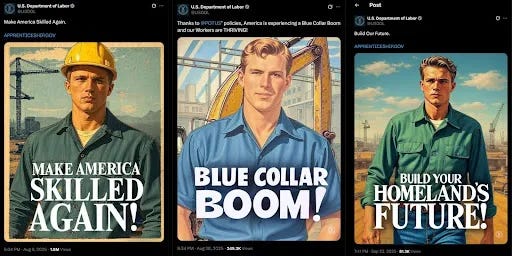
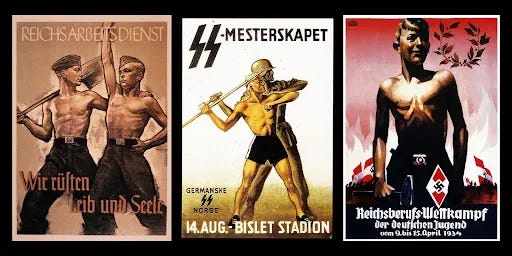
And it is not just the bureaucracy. Trump himself has called immigrants “vermin” and said they are “poisoning the blood of our country,” language taken nearly verbatim from Mein Kampf. When confronted about it, he repeated it. In November 2025, he reposted an AI-generated image of himself enthroned beneath an emblem that bore a striking resemblance to the Nazi war eagle. On Inauguration Day, Elon Musk twice performed a straight-arm salute from the stage at the inaugural rally. Neo-Nazi groups celebrated it. Musk responded by posting Nazi-themed jokes to his 200 million followers. Steve Bannon and others repeated the salute at CPAC the following month. The once-taboo gesture is being normalized.
When asked about any of this, the DHS spokesperson said: “Calling everything you dislike ‘Nazi propaganda’ is tiresome.” The White House said: “This line of attack is boring and tired. Get a grip.”
Immigrants have been transformed from a policy question into an enemy class. They are not people about whom we disagree on the proper rate of admission. They are invaders, criminals, animals, a pestilence. The language is eliminationist and it is being deployed by the official communications apparatus of the United States government to recruit the largest law enforcement expansion in federal history. The masked agents are the enforcement arm. The camps are the logical conclusion. This is the oldest play in the authoritarian handbook: create an enemy, demonize the enemy, use the enemy to justify extraordinary powers, then never give the powers back.
The Christian nationalism is the binding agent. It supplies the moral vocabulary for an enterprise that would otherwise be nakedly about money and power. It tells the faithful that Trump is an instrument of divine will, which is convenient because divine will is hard to audit. It provides the aesthetic—the flags, the hymns, the reverence—that transforms a kleptocratic regime into a crusade. Without it, you’d have to explain why a billionaire who has cheated on every wife and stiffed every contractor is the champion of the common man. With it, you just say God works in mysterious ways and move on.
The Whole Shape
So. Here we are. Step back far enough and the panorama assembles itself.
The money is being taken. The symbols are being branded. The watchdogs have been put down. The machinery of the state has been turned to the service of one man and his circle. The military acts on his word alone. The economy operates at his pleasure. The elections are being brought under federal control. A mythology of national renewal, dressed in the imagery of the Third Reich, provides the soundtrack. And FBI files about the President and a child have gone missing from the database of the department that bears his face.
None of this is hidden, which is perhaps the most disorienting thing about it. The banner is seventy feet tall. The crypto wallets are public. The pardons are announced on social media. The self-dealing is conducted with the cheerful shamelessness of a man who knows that nobody is going to stop him, because he has fired everyone whose job it was to stop him, and the legislature that might have intervened is instead sending him letters of congratulation.
Eisenhower warned about a party that is merely a conspiracy to seize power. What we are living through is what happens after the conspiracy succeeds. The power has been seized.
The question is what we do about it.
November
Garry Kasparov, who grew up inside the Soviet system and has spent decades studying how democracies die, has been saying something that I think is exactly right: the 2026 midterm elections are the last structural opportunity to impose accountability on this administration. Not the last chance in some vague, inspirational sense. The last mechanism.
Here is why. If Democrats take the House, they gain subpoena power. They can compel testimony. They can haul administration officials and family members in for depositions under oath. They can investigate the crypto ventures, the missing Epstein files, the UAE chip deals, the command economy, the voter roll seizures, every last thing I have described in this piece. They can defund ICE and CBP. They can reassert the power of the purse. They can hold hearings that put the receipts on national television. They can, if they find the spine, begin impeachment proceedings.
If Republicans hold Congress, none of that happens. The oversight committees continue to function as rubber stamps. The watchdogs stay dead. The grift continues. The consolidation accelerates. And by 2028, the question of whether there is a free and fair presidential election becomes very much an open one because the man who is seizing state voter rolls and federalizing election administration will have had two more years to entrench himself.
This is why Trump is obsessed with elections. He understands the math. A Democratic Congress is the one thing that can threaten him, because it is the one remaining institution with the constitutional authority to investigate, to defund, and to remove. Everything else—the courts, the agencies, the press—has either been captured, intimidated, or rendered irrelevant. Congress is the last lever. And it is currently in the hands of people who will not pull it.
That can change in November. It is the only thing that can change in November. And that makes it the most important election of our lives, which is a phrase that has been so overused it has lost all meaning, except that this time it is simply, arithmetically true. Win the House and there is a path back. Lose it and the path narrows to something close to nothing.
Kasparov has warned that strongmen depend on their opponents getting weary, on people turning away from politics out of exhaustion and disgust. The overwhelm I described at the beginning of this piece, the feeling of drowning in the sheer volume of it, is not a side effect of what is happening. It is the intended result. They want you tired. They want you to stop reading. They want you to decide that it’s too much, that none of it matters, that your vote won’t make a difference, that the system is already too far gone.
Do not give them that. The system is badly damaged but it is not gone. The tools of accountability still exist. They are sitting in a locked drawer labeled “Congressional Majority.”
The key is in your hands.
I woke up at 4:00 am and the baby was murmuring and the country was at war and the President hadn’t asked anyone’s permission and I sat down to write about it, and then I realized that I couldn’t write about just that, because just that is never just that, because all of it is the same thing, and the same thing is very simple: a man and his friends are taking everything that isn’t nailed down, and then they are pulling up the nails, and then they are taking those too.
Congress is just watching them do it.
But there will be a new Congress in January 2027. What kind of Congress that is depends on what we do between now and November. That is the work. Not the end of the fight, winning the midterms is a necessary condition, not a sufficient one, but the battle that cannot be lost.
So do not look away. Do not get tired. Do not let the volume of the assault convince you that resistance is futile. It is not futile. It is arithmetic. Seats and votes and majorities and subpoenas. The boring, tedious, grinding machinery of democracy, which is the only machinery that has ever worked.
Get to work.
Hannah Yost has a good piece about this, where I grabbed these screenshots.
Terrifying. Accurate. Saddening.